• About Real Estate Wisdom
  • Blog of Wisdom
  • Testimonials
  • Contact

Atlanta Real Estate Wisdom

~ the source for Atlanta real estate expertise

Atlanta Real Estate Wisdom

Tag Archives: mortgage

The Wonderful World of Atlanta Mortgage Lending

08 Thursday Sep 2016

Posted by Mary Anne Walser, REALTOR in real estate

≈ Leave a comment

Tags

atlanta, Atlanta Metro, buyer, buying, buying a home, buying process, home buyer, home buying, interest rates, lender, lending, mortgage, mortgage loan, real estate, underwriting

20160907_110905

The Wonderful World of Atlanta Mortgage Lending

Mary Anne Walser, Realtor & Attorney, 404-277-3527, maryannesellshomes@gmail.com

Tony was a first time homebuyer. He balked at my requirement that buyers be prequalified by a lender before we go out looking at property. “I don’t want to share my personal financial information,” he said. “Well,” I laughed, “welcome to the world of mortgage lending.” Not only your personal financial information, but lots of information that you think would not even be relevant to the purchase of property must be shared with strangers (the mortgage banker and staff).

I always prepare buyers for the fact that they will be asked for a LOT of information. I joke that the lender will even ask them for their third grade report card (being particularly interested in their math scores). A recent buyer – Mia – called me up laughing one day. “You remember when you said they’d ask for my third grade report card? Well, you were almost right. The lender wants my college transcripts!” Now, Mia was well out of college and fully ensconced in her current job for at least two years. But this is just an illustration that there is no telling what the lender is going to ask to see. The best I can do for you is prepare you so you aren’t surprised. Get together everything that the lender will likely need (see the list below), but then be ready that they may ask for much much more. Like your third grade report card.

Here are some of the documents you should have ready for your lender:

  • W-2 forms from the previous two years, if you collect a paycheck.
  • Profit and loss statements or 1099 forms, if you own a business or are an independent contractor.
  • Recent paycheck stubs.
  • Most recent federal tax return, and possibly the last two tax returns.
  • A complete list of your debts, such as credit cards, student loans, car loans and child support payments, along with minimum monthly payments and balances.
  • List of assets, including bank statements, mutual fund statements, real estate and automobile titles, brokerage statements and records of other investments or assets.
  • Canceled checks for your rent or mortgage payments.

This is by no means an exhaustive list. If you have had credit problems or a complicated work history, be prepared to produce even more documents. And the requests just keep coming, sometimes right up to and on the day of closing. The lender may also pull your credit report again right before closing. That’s why we tell you not to make major purchases between loan application and close. WAIT to buy your new furniture and a new car. Big purchases on credit might disqualify you for the loan because they disrupt your income/debt ratio.

So why the need for all this information, borrower laid bare before the mortgage altar? Remember that the lender is giving you a great deal of money to purchase a home. Back in 2006-2008, they were giving money much much too freely. Back then there were even what were called “stated income loans,” where the bank would pull your credit score, ask you what your income was (without any verification requirement) and give you a loan based solely on your credit and what you claimed that you made. You can see where lots of borrowers got into trouble with this. I personally saw real estate agents who I knew did not make a lot of money purchasing huge houses, thinking that they’d be able to resell them at a profit. When the homes didn’t resell, they defaulted. This happened with borrowers of all professions on a national scale – hence the mortgage meltdown.

So now things have tightened up quite a bit, and the documentation requirements are once again onerous. There’s a person called the “underwriter” who you may label the “undertaker” before all is said and done. Your loan officer gathers the preliminary information from you, then hands the file over to the underwriter, whose job it is to “underwrite” the loan. This means that they make sure it conforms with the relevant guidelines and that it is a loan that is likely to be repaid. They require any and all relevant documentation (and some that certainly seems irrelevant) to satisfy the lender that you have the ability to and will repay the loan.

So call a lender and be prepared for the onslaught of requests. Now, let’s talk about the types of lenders. You can call a direct mortgage lender or a mortgage broker – the difference is that a direct lender is lending you money they control. A mortgage broker is shopping around for a loan and is lending you someone else’s money. So a direct lender will usually have more control over the process (through the underwriter, in particular) and the mortgage broker can shop around, but will not have a lot of control over the loan once they choose one for you. I have favorite direct mortgage lenders AND favorite mortgage brokers (call me if you want a referral!) It is just a matter of finding someone experienced and fair.

Most of my buyer/borrowers these days do a 30-year conventional loan, twenty percent down. Interest rates are still so low – I definitely do NOT recommend doing an ARM (“Adjustable Rate Mortgage”). With an ARM, you have a fixed rate for some period of years – three, five or seven – and then when the ARM expires the interest rate resets to a formula based upon the prevailing rates at the time. Since interest rates are SO low now and likely to rise, you would be better off just signing up for one continuous interest rate over years. What if you think you will move before the ARM expires? The ARM rate is generally lower than the conventional loan rate, so that is tempting. But consider that you may change your mind about moving OR about selling. When I purchased my first home, I used a seven-year ARM, convinced that I would move before the seven years were up. I didn’t! But rates were lower at the seven year mark and I refinanced to a 15 year loan instead. And I still own that property (now as a rental). If rates had gone UP, I would have been quite sorry that I had chosen an ARM instead of a fixed rate mortgage.

Find a lender you know and trust, and sit down with them and talk through the wonderful world of mortgage lending and what is best for you. Then let’s go find your home!


Mary Anne Walser is a licensed attorney and full-time REALTOR, serving buyers and sellers in all areas of Metro Atlanta. Her knowledge of residential real estate and her legal expertise allow her to offer great value to her clients. Mary Anne s a member of the Atlanta Board of Realtors, the Georgia Association of Realtors, the State Bar of Georgia and the Georgia Association of Women Lawyers. Contact Mary Anne at 404-277-3527, or via email: maryannesellshomes@gmail.com.



Share this:

  • Click to share on Facebook (Opens in new window) Facebook
  • Click to share on LinkedIn (Opens in new window) LinkedIn
  • Click to share on X (Opens in new window) X
  • Click to email a link to a friend (Opens in new window) Email
  • Click to print (Opens in new window) Print
  • Click to share on WhatsApp (Opens in new window) WhatsApp
  • More
  • Click to share on Reddit (Opens in new window) Reddit
Like Loading...

No Need to Cork the Bubbly – Let’s Celebrate the Recovery

16 Friday Oct 2015

Posted by Mary Anne Walser, REALTOR in real estate

≈ 1 Comment

Tags

atlanta, home buyer, inventory, lender, market, mortgage, price, real estate, sellers

champagne-300x300

After the dismal housing recession in Atlanta (and everywhere) that hit in 2008 and sent housing prices on a sharp decline,  prices finally started to stabilize in late 2014 and have risen ever since.  Having just emerged from the doldrums to a rapid rise in pricing, some experts are declaring a new “housing bubble”; but reports of the imminent death of the rising residential market are greatly exaggerated.

In Atlanta, we took longer to sink during the recession and have been slower to rise in the recovery.  Right now we have a shortage of inventory but our prices still are not rising as quickly as they are in many cities.  This measured response to the national trends bodes well for us; as does the fact that so many companies are bringing headquarters and employees to Atlanta.  We have more buyers moving here, which will naturally put upward pressure on pricing, but which will serve to continue to support that pricing in the coming years as they continue to live and work in Atlanta.

In addition, as more sellers receive the news that housing prices are rising and that they ARE able to sell and make a profit, more are putting their homes on the market.  This additional inventory is helping to reduce the number of competitive bid situations and to stabilize the rapid rise in pricing.

Further, it was a very loose mortgage lending environment that contributed to the original housing bubble.  It was far too easy to get a mortgage at that time.   That loose mortgage environment ground to a screeching halt in 2009 and it is still difficult today to secure a mortgage.  The strict underwriting guidelines that were implemented following the “mortgage meltdown” are still in place, meaning that the torrent of unqualified buyers that precipitated the initial crisis are nowhere to be found and are, hopefully, never to return.  Banks are lending only to qualified buyers with good credit scores who are less likely to default on their mortgage loans.  Interest rates are still low right now, but are likely to rise, which will create yet another governor on the ability of buyers to purchase and the ability of sellers to ask ever increasing prices.

After fifteen years in the business, I have seen a lot of ups and downs in the housing market.  This particular recovery, while fast, has not spun out of control and is unlikely to do so.   While it’s always prudent for a buyer to carefully review the sales of comparable properties and to research the  neighborhood and factors contributing to that neighborhood’s potential before agreeing on price, and although that price is going to be higher than it was three to five years ago, there’s no need to panic or to cork the bubbly over a housing “bubble”.  Rather, we should continue to celebrate the housing recovery.

Mary Anne Walser is a licensed attorney and full-time REALTOR, serving buyers and sellers in all areas of Metro Atlanta. Her knowledge of residential real estate and her legal expertise allow her to offer great value to her clients. Mary Anne serves on the Committee that drafts and reviews the contracts utilized by all REALTORS in the State of Georgia. In addition, she is a member of the Atlanta Board of Realtors, the Georgia Association of Realtors, the State Bar of Georgia and the Georgia Association of Women Lawyers. Contact Mary Anne at 404-277-3527, or via email: maryannesellshomes@gmail.com.
Share this:

  • Click to share on Facebook (Opens in new window) Facebook
  • Click to share on LinkedIn (Opens in new window) LinkedIn
  • Click to share on X (Opens in new window) X
  • Click to email a link to a friend (Opens in new window) Email
  • Click to print (Opens in new window) Print
  • Click to share on WhatsApp (Opens in new window) WhatsApp
  • More
  • Click to share on Reddit (Opens in new window) Reddit
Like Loading...

Chicken Little Goes to Closing

06 Thursday Aug 2015

Posted by Mary Anne Walser, REALTOR in real estate

≈ Leave a comment

Tags

atlanta, attorney, closing, disclosure, home buying, home selling, lender, lenders, mortgage, mortgage loan, real estate, realtor

HUD

The sky is falling! To hear lenders and closing attorneys tell it, the world as we know it comes to an end on October 3rd. That’s the day new regulations come into effect that govern the mortgage lending and closing process. Whether or not there’s mass bedlam, there are certainly changes that buyers and sellers of property should be aware of and prepared for, so this article will summarize them.

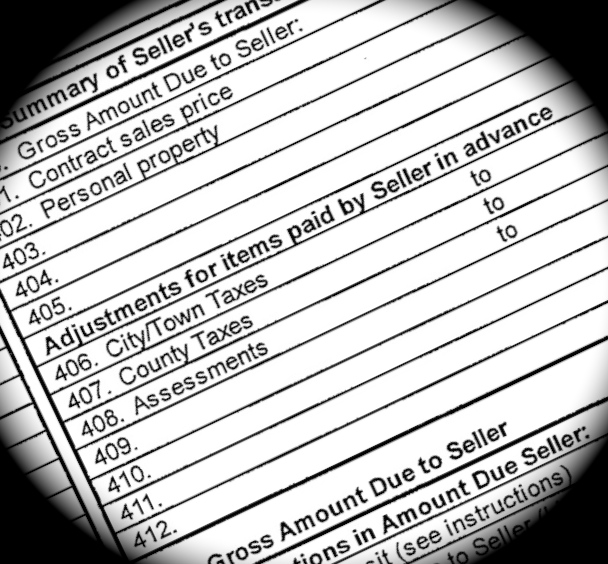
To understand how things are changing, it is important to know how the world works now. Today, sometimes the loan and closing statement will change the day of closing or even while parties are sitting at the closing table. Starting in October, that cannot and will not be possible anymore, at least as to every mortgage application received October 3, 2015 or later. The new rules require that a new document, the Loan Estimate, must be provided to the borrower within three days after loan application, and another new document, the Closing Disclosure, must be provided to the borrower at least three business days prior to closing. These apply to any mortgage loans with no exceptions. If there are changes to the deal, a new disclosure must be provided and the three-day waiting period starts all over. While previously the settlement statement was provided by the closing attorney and often at the last minute, with the new regulations the lenders themselves will likely be providing the statement directly to the borrower and they must confirm and document receipt by the consumer.

You can see how this can potentially cause big problems. “Stacked closings” are common now, in which the seller of one property uses those proceeds to purchase a new property in the next hour from a seller who may the following hour be buying a new property of their own. These back-to-back closings dependent upon one another for consummation are already tenuous at times. Imagine what the new three-day waiting requirement may do! So in practical effect and application, we Realtors must advise our clients of the following:

  • Delays are much more likely, particularly in the early days of implementation of the new regulations.
  • A seller will want to negotiate possession some number of days AFTER closing. While this has always been the case for a seller still living in the property they are selling, now it becomes even more crucial.
  • A buyer will want to commit to a lender as soon as possible in order to attempt to limit any delays. A buyer will want to be sure they choose a lender fully conversant with the new regulations and a lender who has a system in place to comply.
  • While some lenders can get a loan through underwriting and closed quickly, every loan is going to take longer with these new requirements, particularly at first. A cushion of 45 days between contract and close is advisable.
  • From a Realtor’s standpoint, any and all provisions of the contract should be tied up as early as possible. In particular, if there are monetary concessions during the due diligence period, those should be provided to the lender as soon and as early as possible. Even changes in the Realtor’s commission are part of the disclosure process and should be wrapped up as early in the process as possible.
  • While lenders are the primary front line, closing attorneys must also be in line with the new regulations. It is advisable to look for a closing attorney who does residential real estate closings regularly, has systems in place, and preferably is ALTA (American Land Title Association) best practices certified.

The new disclosures are designed to help consumers better understand the terms and costs of their mortgage loan; however, in one aspect the new disclosures are more confusing. The new rule prohibits lenders from disclosing a reduction that is commonly offered by the title insurance companies when a lender’s title policy and the borrower’s title policy are issued at the same time. Instead, there’s one lump sum disclosed; at closing the cost will actually be *less*. While that might result in a pleasant surprise for some at closing, those borrowers who are watching closely will likely be more confused about what, exactly, the title insurance is actually going to cost them at closing.

The home sale and purchase process can be confusing enough. If you are planning to make a move this year, be sure you plan for these new regulations and have trusted advisors guiding you through the process.

Mary Anne Walser is a licensed attorney and full-time REALTOR, serving buyers and sellers in all areas of Metro Atlanta. Her knowledge of residential real estate and her legal expertise allow her to offer great value to her clients. Mary Anne serves on the Committee that drafts and reviews the contracts utilized by all REALTORS in the State of Georgia. In addition, she is a member of the Atlanta Board of Realtors, the Georgia Association of Realtors, the State Bar of Georgia and the Georgia Association of Women Lawyers. Contact Mary Anne at 404-277-3527, or via email: maryannesellshomes@gmail.com.

Share this:

  • Click to share on Facebook (Opens in new window) Facebook
  • Click to share on LinkedIn (Opens in new window) LinkedIn
  • Click to share on X (Opens in new window) X
  • Click to email a link to a friend (Opens in new window) Email
  • Click to print (Opens in new window) Print
  • Click to share on WhatsApp (Opens in new window) WhatsApp
  • More
  • Click to share on Reddit (Opens in new window) Reddit
Like Loading...

A HOUSE DIVIDED: The Family Home in a Divorce

27 Friday Sep 2013

Posted by Mary Anne Walser, REALTOR in real estate

≈ Leave a comment

Tags

atlanta, attorney, buy, closing, divorce, home, house, loan, mortgage, real estate, realtor, sell

“When we divorced we split the house 50/50 – she got the inside and I got the outside.”

 “Have you seen the new “Divorcing Barbie” doll? She comes with Ken’s house.”

House Divided

             Joking aside, the family home is sometimes the greatest asset to divide in a divorce – so let’s look at how to handle this crucial asset.

It is advisable to call a Realtor early on, when you’re analyzing what assets you have and don’t have.  I often get called in to look at the home and give an assessment of its value in today’s market.  It makes sense to call a Realtor at this point – we typically are more familiar with the neighborhood and have been in the homes that are for sale and have sold, and are accustomed to pricing properties for sale.

There are online tools you can use as well – zillow.com, for instance, which gives you a “zestimate” of what your home is worth, or trulia.com.  However, these services have obviously not been inside your home or the other homes – so they are very general and cannot necessarily be relied upon.  Tax records are also notoriously unreliable.

A crucial consideration at this point may be whether or not the couple is “underwater”; that is, whether you owe more on the property than the property is worth.   If so, to sell the home you would have to bring money to the table.  In other words, in some instances it may not be possible to sell the home.

Also consider early on whether or not you want to fight to keep the home.  Can you afford the monthly carrying costs?  It might not be worth fighting for if it’s something you cannot keep up.

If one party does end up staying in and keeping the home, however, that party may be buying the other party out.  In that instance, professional appraisals are probably in order – each side getting their own appraisal and then perhaps a third appraisal if the two vary widely.  Know that appraisals are an ART as well as a science – while appraisers are bound by the Uniform Appraisal Guidelines and professional dictates, there is some subjectivity in the process.  When you hire an appraiser, you might wish to share with them the comparable sales that you think are most applicable and why they should be used.  Most appraisers are happy to consider the information, although of course they are not bound to use it.

But say the decision is that the home needs to be SOLD.  It’s great if you can both agree on a Realtor.  That actually happens much more often than you might think.  Maybe you both liked the Realtor who sold you the home.  Or know a Realtor jointly who you respect.  Another tactic is to interview three Realtors and see if there’s a clear front runner who you can agree upon.  If not, one way this is sometimes handled is that one party will choose the Realtor for a specified period of time and the other party will choose for the next period – be it 3 months or 6 months.

Several considerations arise here.  Keep in mind that there are various expenses involved in getting the home ready for sale and keeping it maintained while it is on the market.  How those expenses are handled should be decided upon in advance.  You might also want to decide in advance how much the list price will be decreased and when – and what offers should be acceptable (i.e., you can agree that any offer within five percent of list price must be accepted, that sort of thing).

Then there are some very practical showing considerations.  An example will illustrate this point.  We had one client where the wife left with all the nice furniture.  We were left showing a home with very little furniture and a “divorce feel.”  Try to agree to keep enough nice things in the home to make it show well.  Like it or not, buyers are swayed by these things.  Most buyers choose emotionally and THEN justify the purchase logically.  If they walk in and the home feels forlorn and empty, they will not feel great about the home – or may think the seller is in desperate circumstances and thus make a lower offer.  It pays off to have the home nice for showings.  If nothing else, the parties can agree to borrow or rent furniture or to have the home staged for showings.

The home must also be AVAILABLE for showings.  This becomes an issue when the person staying in the home doesn’t necessarily want the home to sell.  Perhaps the other party is paying the bills, and so once the home sells the occupying party loses that support AND must move to a lesser home.

When an offer comes in, keep in mind that your net is less the Broker’s commissions, the mortgage payoff(s) and any repairs that will be necessitated during the inspection period.  Your Realtor can help you figure your net from a given offer.  Again, it is sometimes helpful here to have agreed what amount and type of offer should be acceptable.

A note here if one party stays in the home.  Be aware of title issues.  When you sell the home, a title search is performed.  If there are any liens against the property, these must be paid off before closing.  Even if you do not sell the home, if you are the one keeping the home you want to have a title search before all is finalized.  That way you can be sure the departing spouse didn’t borrow money against the house or otherwise create liens that you will be responsible for when you sell the house and which effect its value.

The final issue – housing options once you leave the family home.  This is for you and your Realtor to decide, but just a few things to keep in mind: do you need to stay in the same school district for the kids?  Do you need to stay close to the other spouse for the children’s sake?  Even the priciest zip codes have affordable options that your Realtor can help you find.  And keep in mind that emotionally you may want to stay in a familiar area; the one you’ve lived in or an area with friends and family near.

Share this:

  • Click to share on Facebook (Opens in new window) Facebook
  • Click to share on LinkedIn (Opens in new window) LinkedIn
  • Click to share on X (Opens in new window) X
  • Click to email a link to a friend (Opens in new window) Email
  • Click to print (Opens in new window) Print
  • Click to share on WhatsApp (Opens in new window) WhatsApp
  • More
  • Click to share on Reddit (Opens in new window) Reddit
Like Loading...

THE APPRAISAL PROBLEM

11 Monday Feb 2013

Posted by Mary Anne Walser, REALTOR in real estate

≈ Leave a comment

Tags

agent, Appraisal contingency, Atlanta market inventory, buyer, buying, comparable properties, construction, contract price, geographic radius, home, house, listings, mortgage, neighborhood, payout, property seller, real estate, realtor, school districts, sell, selling, sold, Square footage, style

Appraisal BalanceYou have probably heard this by now, but the Atlanta market, in most areas, is rapidly becoming a SELLER’S market again! We have more buyers than we have good, well-priced inventory, and as a consequence listings that are in good condition and well-priced are going quickly, sometimes with multiple bids.

Sounds great for sellers, and it is – but there is also a catch.

Almost every final purchase contract contains an appraisal contingency. The appraisal contingency states that the property must appraise at or above the contract price. If the property does NOT appraise, the buyer presents the appraisal to the seller, and the seller has the opportunity to agree to pay at the reduced appraisal price. If the seller does not agree to that, the buyer may terminate.

Here is where we often get into a big problem. By definition, appraisals are backward looking. The appraiser looks at similar properties that have sold in the recent past within a certain geographic radius. Even when the market is rapidly improving, the appraiser is bound by the sales that took place in the past. So as you can see, prices cannot rebound suddenly and quickly; the appraisal process does not allow that. Prices must rise more slowly and steadily, as appraisals must build upon homes that have already sold. Good appraisers will also research other properties currently under contract and set to close, which is helpful; but cannot completely take into account a market where suddenly there are more buyers willing to pay more for houses.

To illustrate, good well-priced homes are selling with multiple bids within days of being put on the market (or even BEFORE we list them). The contract price is often higher than the home will appraise for, so buyers are even, in some instances, agreeing to pay extra cash to pay ABOVE appraised value. There is one listing where the buyer agreed to pay $75,000 OVER the appraised price; while that is more than most buyers would be willing to cover, there are others willing to pay more than the appraisal says the property is worth.

And it’s not just home sellers who need to take this into consideration. Any homeowner who has a need to determine the current value of the property should take heed of this dynamic.  For instance, divorces. What this means is that if you are the divorcing party accepting a “payout” you may want to either wait some period of time before you agree to appraise the house for  the payout, bargain for a higher payout that might otherwise be negotiated, or provide in the settlement that there will be another appraisal in a year, having the party keeping the house pay you half of the increase in value in the home at that time.

If you are curious what your home might be worth in this market, here are some of the pertinent factors.  If you contact a Realtor, while they are not appraisers, they can pull comparable properties for you and give you an idea of what your property might be worth in this market:

  • How many beds/baths?
  • What type construction (brick, frame, vinyl or stucco?)
  • What style (two story, ranch, split level?)
  • What year was the house built?
  • Any significant upgrades or renovations and if so, what year – and a short description of what was done.
  • Parking – is there a garage or carport?  Two car?
  • Square footage of the home and acreage of the lot.
  • Neighborhood and school districts.

Armed with this information, a Realtor can help you determine whether or not your home is in a high demand area and poised to receive top dollar in this improving market. Just keep in mind that you should also have a strategy for handling the appraisal if it comes in lower than your contract price.

Share this:

  • Click to share on Facebook (Opens in new window) Facebook
  • Click to share on LinkedIn (Opens in new window) LinkedIn
  • Click to share on X (Opens in new window) X
  • Click to email a link to a friend (Opens in new window) Email
  • Click to print (Opens in new window) Print
  • Click to share on WhatsApp (Opens in new window) WhatsApp
  • More
  • Click to share on Reddit (Opens in new window) Reddit
Like Loading...

How do you know when the PRICE IS RIGHT?

06 Wednesday Feb 2013

Posted by Mary Anne Walser, REALTOR in real estate

≈ 1 Comment

Tags

agent, buying, comparable market analysis, dollar, home, house, Just Listed, list price, market, mortgage, property, real estate, right price, selling

House Price2

What’s the “right price” when you’re selling your home?  The longer your home sits on the market the less you’ll ultimately get for it, so you want to sell fast at top dollar; everyone does (and should).  How can we do that?  What’s the ultimate list price to accomplish your objective?  It’s a little trickier in the current environment, where we are low on housing inventory and it’s turning into a seller’s market.  It’s tempting to overprice.  But the key is to determine what price will draw those eager buyers and still get you top dollar for your home.  That’s where we step in.

First, remember that the list price should not be based on what you paid for the property, what you need to pay off the mortgage or what the price to rebuild the home would be today. What truly sets the right price is what a willing buyer is willing to pay RIGHT NOW and quickly, afraid that if they don’t buy it right away someone else will.  So the right list price takes into account a number of factors, including what other homes are out there that you’ll be competing with, and what’s sold recently in your neighborhood.

We do a comparable market analysis (CMA) for your property to help find this value. The CMA will compare your property to similar properties in your area that have sold in the past 6 months. This analysis takes in to consideration size, condition and improvements. Then we take a look at what is currently out there – the homes you are competing against.  Are you the best at the price you are asking?  That is what we are striving for.  You can see from the chart below that CONDITION is as much a factor as pricing.  You want to be the home that’s in the best condition at the lowest price – and that’s how you get “chosen” by a buyer.

Chart 1 - In market

In order to steal buyers’ attention from all the other listings you have to be better than the rest at the price you’ve chosen.  Listing your property as little as 10% above your determined market value will mean that that you will lose many potential buyers (according to the chart below, seventy percent!) who won’t even see your home because it’s overpriced.

Chart 2 - Triangle

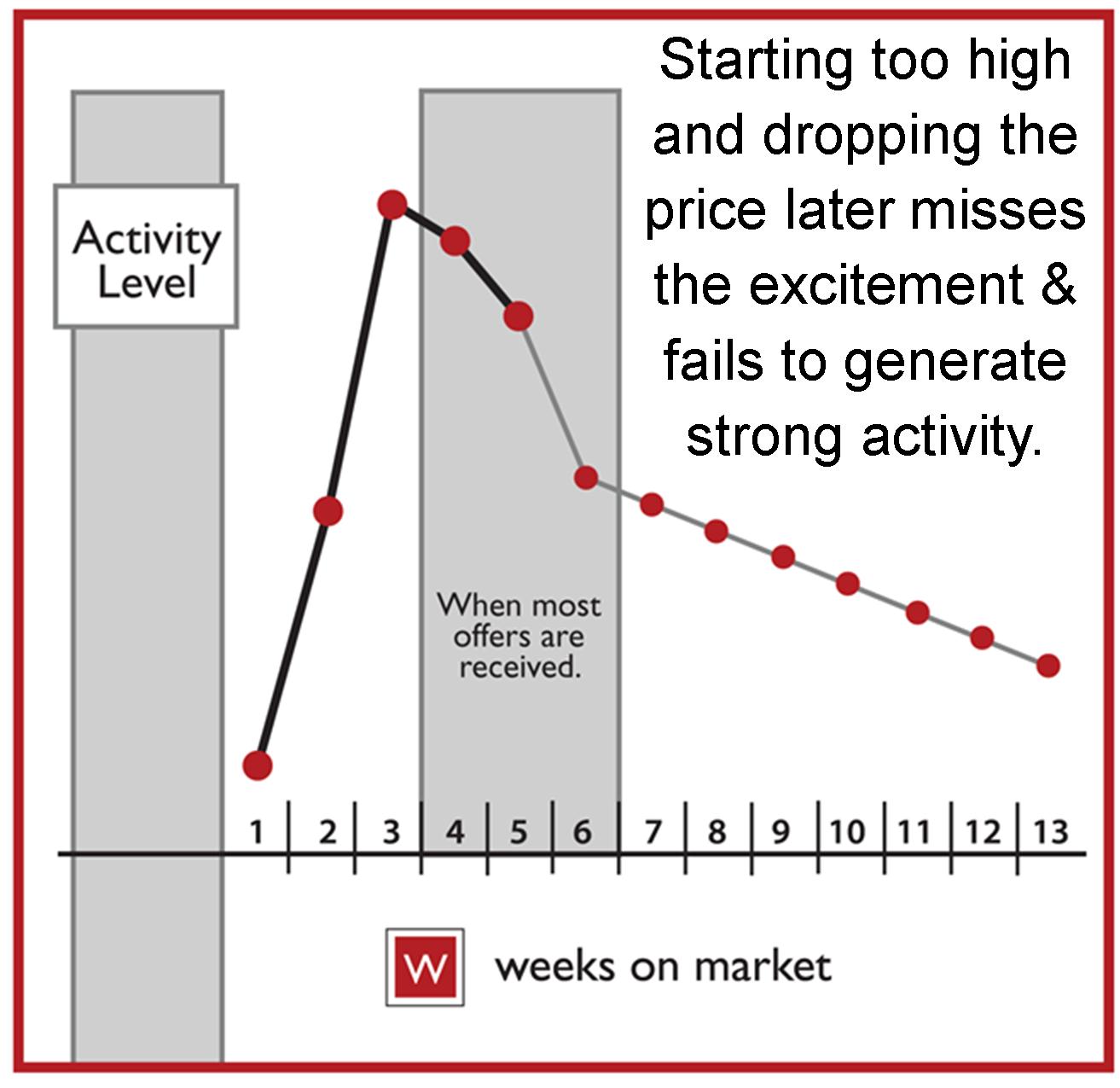
The third and last step to price your property “right” is to take FULL advantage of the first 30 days that your property is on the market. Do not fall into the trap of “trying out” an above market price for a few days just to “see if it sells”. Many sellers make this mistake and end up selling below market value. Your listing attracts the most buyers when it first hits the market. All buyers are on the lookout for “Just Listed” properties every day. If your property is listed above market value from the start, it will be missed by all those potential buyers. After even the second week of listing, property showings begin to drop.  So if you don’t have ANY showings the first two weeks, you are clearly overpriced and should drop immediately – it is already almost too late!

Chart 3 - bar graph

If you are ready to sell fast and get a great deal on your property call me today.  I will provide you with a thorough CMA specialized for your unique property so we can determine the “right” price and sell fast.

Share this:

  • Click to share on Facebook (Opens in new window) Facebook
  • Click to share on LinkedIn (Opens in new window) LinkedIn
  • Click to share on X (Opens in new window) X
  • Click to email a link to a friend (Opens in new window) Email
  • Click to print (Opens in new window) Print
  • Click to share on WhatsApp (Opens in new window) WhatsApp
  • More
  • Click to share on Reddit (Opens in new window) Reddit
Like Loading...

Obtaining a Mortgage: 3 Steps to Improve Your Credit Score

19 Thursday Apr 2012

Posted by Mary Anne Walser, REALTOR in real estate

≈ Leave a comment

Tags

atlanta, billing, credit fraud, credit report, credit score, debt, Equifax, Experian, finance, Georgia, home buying, home selling, lending, loan, mortgage, real estate, TransUnion

Right after the mortgage meltdown, it was very difficult to obtain a mortgage.  It is still not especially easy, and I find that some buyers have credit scores that either prohibit them from getting a mortgage or make it difficult to get a good rate.

The first step to improving your credit score is to get a current copy of your credit report. There are three nationwide consumer credit reporting companies that provide reliable credit reports. Those companies are: Equifax- www.investigate.equifax.com, Experian – www.experian.com and TransUnion – www.transunion.com.  At AnnualCreditReport.com you can get a copy of your credit report from one of these companies absolutely free. To report false information that appears on your report you may contact the nationwide consumer credit reporting company that provided the credit report. The time it will take to correct your report depends on the specific error contained in your report, but no matter the length of time, getting your credit information corrected is your best and only option because your credit is at stake.

The second step to improving your credit score is to take control of your monthly debt. Your credit score reflects what you owed at the time of your last billing cycle and the amount of credit that you have available. People with the highest credit scores only use 10% of their total available credit each month. To maintain good credit you must keep your monthly debt under 25% and not utilize more than 25% of your available credit each month.

The third step to improving your credit score is to remember that “credit” cards don’t always benefit your credit. Paying off the balance on your credit card every month will not always improve your credit score. At the end of each billing cycle the full amount that you owe on that card is posted on your credit score, even if you paid your monthly charge. Once you have paid off the full balance on a credit card, do not cancel it. Canceling a credit card will lower your credit score, even if you have paid it off. Mortgage companies suggest that if you plan to purchase a home, you should not make any purchases with your credit card 3 to 6 months before you plan to secure financing for your new home. Instead, use cash or debit to pay for purchases during those months so you can enhance your credit worthiness.

Overall, your credit score is only a small part of your complete financial standing, but it is one of the most important because it proves your responsibility for paying off your debt. Don’t miss out on the historically low mortgage interest rates that are being offered. There’s no requirement for you to have outstanding income and a high down payment if you have good credit. Improving your credit score will give you an opportunity to take advantage of a low interest rate. Follow these 3 easy steps to improving your credit score and be on your way to owning a new home!

Share this:

  • Click to share on Facebook (Opens in new window) Facebook
  • Click to share on LinkedIn (Opens in new window) LinkedIn
  • Click to share on X (Opens in new window) X
  • Click to email a link to a friend (Opens in new window) Email
  • Click to print (Opens in new window) Print
  • Click to share on WhatsApp (Opens in new window) WhatsApp
  • More
  • Click to share on Reddit (Opens in new window) Reddit
Like Loading...

WHAT I LEARNED FROM BUYING A HOME – GETTING A MORTGAGE LOAN

20 Friday Jan 2012

Posted by Mary Anne Walser, REALTOR in real estate

≈ Leave a comment

Tags

atlanta, closing, home buying, lenders, loan, Loan officer, money, mortgage, purchase, real estate, underwriting

Image

I vaguely recall getting a loan when I purchased my first home.  And what I remember is that it did not seem all that difficult, but that the closing was a nightmare.  The loan officer did not show up for closing, there were charges on the closing statement that hadn’t been revealed to me previously, and the loan officer was nowhere to be found.  As a result, the closing was much more arduous and took a lot longer than it should have.

And while I work with clients every day who are getting a loan to purchase their homes, most of my clients work with my favorite lender.  He makes the process appear seamless to me as a Realtor.  He is patient, explains everything carefully to them, and always answers the phone or returns calls promptly.  So in recent years I have been less aware of what getting a loan is really like.

So when I convinced my husband that buying another home was a great idea, I was not really sure exactly what to expect.  I called my favorite loan officer.  And even though he made the process as easy as possible for me – I had forgotten all the information you need to provide for the loan – recent pay stubs, W-2 statements, tax returns for the last few years.  You will need to get with your lender and fill out forms, provide the documents, and then provide more documents as issues come up.  For instance, my husband was divorced from his first wife, but continued to pay alimony for a period of time after the divorce.  The lending underwriter needed to see the divorce settlement to determine when those obligations ended.  Why, I am not really sure.  But that is how it goes in the lending world these days.  The best advice I can give is to get all your important tax, account and legal papers together and organized and have them ready.  Some documents you may not even know that you need until the very last minute, when the loan goes through final underwriting.  Luckily, although the call came for that divorce document at the last minute and while my husband was overseas, I was able to locate it quickly in his organized files.

So, lesson one – have all important papers ready and handy and make sure that you have filed your income taxes regularly, particularly for the most current year.  I already knew not to make any large purchases between applying for the loan and closing.  Lenders do not like to see large sums of money going OUT of your account(s) during that time.  Now, lots of buyers purchase appliances, furniture, that sort of thing – if it is a large purchase, just run it by your loan officer before you do it.

The other part of this lesson is something I already knew: HAVE A LOAN OFFICER WHO IS ACCESSIBLE, AVAILABLE, AND RETURNS YOUR PHONE CALLS PROMPTLY.  Loans are more difficult these days.  You want someone who can guide you through the process and make sure everything goes great at closing.  Have what I had the second time – a seamless, efficient closing with no surprises that was over in less than an hour.  Do not have a closing like my first one – and you can avoid that by finding the right lender.

Share this:

  • Click to share on Facebook (Opens in new window) Facebook
  • Click to share on LinkedIn (Opens in new window) LinkedIn
  • Click to share on X (Opens in new window) X
  • Click to email a link to a friend (Opens in new window) Email
  • Click to print (Opens in new window) Print
  • Click to share on WhatsApp (Opens in new window) WhatsApp
  • More
  • Click to share on Reddit (Opens in new window) Reddit
Like Loading...

The Home Search

11 Friday Nov 2011

Posted by Mary Anne Walser, REALTOR in real estate

≈ Leave a comment

Tags

Buckhead, closing costs, condo, down payment, earnest money, for sale, home buying, home insurance, Home Search, inspection, interest, interest rates, money, mortgage, offer, principal, real estate, taxes, townhome

A previous blog post was on how much money you’ll need before you search for a home – basically going through the down payment you’ll need, the money for an inspection or inspections, earnest money, closing costs and the like.  So, you’ve saved the money you need.  What happens now?

First, if you aren’t prequalified already, meet with a Lender and get prequalified.  This will let you know how much you can afford to pay for a home.  Even IF you don’t want to spend the entire amount you can qualify for, you’ll know how high you can go.  The other calculation, then, is at what price point you’ll be comfortable.  Consult mortgage payment tables, which calculate principal and interest at given interest rates, then remember to add in a sum for taxes and insurance.  The four elements of your monthly mortgage payment will be that: PITI, or principal, interest, taxes and insurance.

It’s definitely a good idea to figure this out BEFORE you start looking for homes.  There’s nothing more frustrating than looking at homes way above your price range and then discovering you have to settle for something much less.  Plus, when you do get ready to make an offer you’ll need a prequalification letter.  If you’ve already spoken to a lender, you’ll be able to get one of those quickly when the time comes.

Price often dictates neighborhood – and property type.  If you are in a lower price range, but set on living in Buckhead, for instance, you’ll need to look for a condo or townhome.  Your agent can help you identify, in your range, where it is possible for you to live.  We can then set up a property search accordingly.

We have lots of cool tools these days for that – I can set my buyers up on automatic notification, so that when a new home meeting their criteria comes on the market, they know immediately.  But of course, I also look at the new listings every day, and quiz other buyers about unlisted properties, to determine whether there’s something “new” out there for one of my buyers.

So, you search – and if you have targeted correctly, you might be able to find your dream home relatively quickly.  At that point, it is time to MAKE AN OFFER – which will be the subject of a future blog post… so STAY TUNED!!!

Share this:

  • Click to share on Facebook (Opens in new window) Facebook
  • Click to share on LinkedIn (Opens in new window) LinkedIn
  • Click to share on X (Opens in new window) X
  • Click to email a link to a friend (Opens in new window) Email
  • Click to print (Opens in new window) Print
  • Click to share on WhatsApp (Opens in new window) WhatsApp
  • More
  • Click to share on Reddit (Opens in new window) Reddit
Like Loading...

  • Mary Anne Walser, REALTOR's avatar

Archives

  • June 2022 (1)
  • February 2022 (1)
  • April 2021 (1)
  • February 2021 (1)
  • August 2020 (1)
  • June 2020 (1)
  • February 2020 (1)
  • October 2019 (1)
  • January 2019 (1)
  • December 2018 (1)
  • November 2018 (1)
  • September 2018 (1)
  • August 2018 (1)
  • June 2018 (2)
  • April 2018 (1)
  • March 2018 (1)
  • February 2018 (1)
  • January 2018 (1)
  • November 2017 (1)
  • October 2017 (1)
  • September 2017 (1)
  • August 2017 (1)
  • July 2017 (1)
  • June 2017 (2)
  • February 2017 (1)
  • January 2017 (2)
  • November 2016 (2)
  • October 2016 (1)
  • September 2016 (2)
  • August 2016 (1)
  • July 2016 (1)
  • June 2016 (3)
  • May 2016 (3)
  • April 2016 (2)
  • March 2016 (1)
  • January 2016 (1)
  • December 2015 (1)
  • November 2015 (1)
  • October 2015 (2)
  • August 2015 (1)
  • June 2015 (1)
  • March 2015 (1)
  • February 2015 (2)
  • December 2014 (1)
  • August 2014 (1)
  • June 2014 (2)
  • January 2014 (3)
  • December 2013 (2)
  • September 2013 (1)
  • August 2013 (1)
  • July 2013 (2)
  • June 2013 (1)
  • April 2013 (1)
  • March 2013 (3)
  • February 2013 (3)
  • January 2013 (2)
  • November 2012 (2)
  • October 2012 (1)
  • August 2012 (2)
  • July 2012 (1)
  • May 2012 (1)
  • April 2012 (2)
  • March 2012 (3)
  • February 2012 (3)
  • January 2012 (2)
  • December 2011 (2)
  • November 2011 (3)
  • October 2011 (3)
  • September 2011 (3)
  • August 2011 (6)

Recent Posts

  • Where Sellers Go
  • 2022 A (real estate) Space Odyssey & Oddities
  • Renovate or Relocate!?
  • OWNING A PIECE OF ATLANTA HISTORY
  • Your Atlanta Pandemic Real Estate Plan

Enter your email address to subscribe to this blog and receive notifications of new posts by email.

Join 4,045 other subscribers
  • RSS - Posts
Follow Atlanta Real Estate Wisdom on WordPress.com

Mary Anne Walser, Realtor & Licensed Attorney

Keller Williams Realty
3650 Habersham Rd.
Atlanta, GA 30305
404-277-3527

Blog at WordPress.com.

  • Subscribe Subscribed
    • Atlanta Real Estate Wisdom
    • Join 82 other subscribers
    • Already have a WordPress.com account? Log in now.
    • Atlanta Real Estate Wisdom
    • Subscribe Subscribed
    • Sign up
    • Log in
    • Report this content
    • View site in Reader
    • Manage subscriptions
    • Collapse this bar
 

Loading Comments...
 

    %d