
• About Real Estate Wisdom
  • Blog of Wisdom
  • Testimonials
  • Contact

Atlanta Real Estate Wisdom

~ the source for Atlanta real estate expertise

Atlanta Real Estate Wisdom

Tag Archives: buying process

The Wonderful World of Atlanta Mortgage Lending

08 Thursday Sep 2016

Posted by Mary Anne Walser, REALTOR in real estate

≈ Leave a comment

Tags

atlanta, Atlanta Metro, buyer, buying, buying a home, buying process, home buyer, home buying, interest rates, lender, lending, mortgage, mortgage loan, real estate, underwriting

20160907_110905

The Wonderful World of Atlanta Mortgage Lending

Mary Anne Walser, Realtor & Attorney, 404-277-3527, maryannesellshomes@gmail.com

Tony was a first time homebuyer. He balked at my requirement that buyers be prequalified by a lender before we go out looking at property. “I don’t want to share my personal financial information,” he said. “Well,” I laughed, “welcome to the world of mortgage lending.” Not only your personal financial information, but lots of information that you think would not even be relevant to the purchase of property must be shared with strangers (the mortgage banker and staff).

I always prepare buyers for the fact that they will be asked for a LOT of information. I joke that the lender will even ask them for their third grade report card (being particularly interested in their math scores). A recent buyer – Mia – called me up laughing one day. “You remember when you said they’d ask for my third grade report card? Well, you were almost right. The lender wants my college transcripts!” Now, Mia was well out of college and fully ensconced in her current job for at least two years. But this is just an illustration that there is no telling what the lender is going to ask to see. The best I can do for you is prepare you so you aren’t surprised. Get together everything that the lender will likely need (see the list below), but then be ready that they may ask for much much more. Like your third grade report card.

Here are some of the documents you should have ready for your lender:

  • W-2 forms from the previous two years, if you collect a paycheck.
  • Profit and loss statements or 1099 forms, if you own a business or are an independent contractor.
  • Recent paycheck stubs.
  • Most recent federal tax return, and possibly the last two tax returns.
  • A complete list of your debts, such as credit cards, student loans, car loans and child support payments, along with minimum monthly payments and balances.
  • List of assets, including bank statements, mutual fund statements, real estate and automobile titles, brokerage statements and records of other investments or assets.
  • Canceled checks for your rent or mortgage payments.

This is by no means an exhaustive list. If you have had credit problems or a complicated work history, be prepared to produce even more documents. And the requests just keep coming, sometimes right up to and on the day of closing. The lender may also pull your credit report again right before closing. That’s why we tell you not to make major purchases between loan application and close. WAIT to buy your new furniture and a new car. Big purchases on credit might disqualify you for the loan because they disrupt your income/debt ratio.

So why the need for all this information, borrower laid bare before the mortgage altar? Remember that the lender is giving you a great deal of money to purchase a home. Back in 2006-2008, they were giving money much much too freely. Back then there were even what were called “stated income loans,” where the bank would pull your credit score, ask you what your income was (without any verification requirement) and give you a loan based solely on your credit and what you claimed that you made. You can see where lots of borrowers got into trouble with this. I personally saw real estate agents who I knew did not make a lot of money purchasing huge houses, thinking that they’d be able to resell them at a profit. When the homes didn’t resell, they defaulted. This happened with borrowers of all professions on a national scale – hence the mortgage meltdown.

So now things have tightened up quite a bit, and the documentation requirements are once again onerous. There’s a person called the “underwriter” who you may label the “undertaker” before all is said and done. Your loan officer gathers the preliminary information from you, then hands the file over to the underwriter, whose job it is to “underwrite” the loan. This means that they make sure it conforms with the relevant guidelines and that it is a loan that is likely to be repaid. They require any and all relevant documentation (and some that certainly seems irrelevant) to satisfy the lender that you have the ability to and will repay the loan.

So call a lender and be prepared for the onslaught of requests. Now, let’s talk about the types of lenders. You can call a direct mortgage lender or a mortgage broker – the difference is that a direct lender is lending you money they control. A mortgage broker is shopping around for a loan and is lending you someone else’s money. So a direct lender will usually have more control over the process (through the underwriter, in particular) and the mortgage broker can shop around, but will not have a lot of control over the loan once they choose one for you. I have favorite direct mortgage lenders AND favorite mortgage brokers (call me if you want a referral!) It is just a matter of finding someone experienced and fair.

Most of my buyer/borrowers these days do a 30-year conventional loan, twenty percent down. Interest rates are still so low – I definitely do NOT recommend doing an ARM (“Adjustable Rate Mortgage”). With an ARM, you have a fixed rate for some period of years – three, five or seven – and then when the ARM expires the interest rate resets to a formula based upon the prevailing rates at the time. Since interest rates are SO low now and likely to rise, you would be better off just signing up for one continuous interest rate over years. What if you think you will move before the ARM expires? The ARM rate is generally lower than the conventional loan rate, so that is tempting. But consider that you may change your mind about moving OR about selling. When I purchased my first home, I used a seven-year ARM, convinced that I would move before the seven years were up. I didn’t! But rates were lower at the seven year mark and I refinanced to a 15 year loan instead. And I still own that property (now as a rental). If rates had gone UP, I would have been quite sorry that I had chosen an ARM instead of a fixed rate mortgage.

Find a lender you know and trust, and sit down with them and talk through the wonderful world of mortgage lending and what is best for you. Then let’s go find your home!


Mary Anne Walser is a licensed attorney and full-time REALTOR, serving buyers and sellers in all areas of Metro Atlanta. Her knowledge of residential real estate and her legal expertise allow her to offer great value to her clients. Mary Anne s a member of the Atlanta Board of Realtors, the Georgia Association of Realtors, the State Bar of Georgia and the Georgia Association of Women Lawyers. Contact Mary Anne at 404-277-3527, or via email: maryannesellshomes@gmail.com.


Share this:

  • Click to share on Facebook (Opens in new window) Facebook
  • Click to share on LinkedIn (Opens in new window) LinkedIn
  • Click to share on X (Opens in new window) X
  • Click to email a link to a friend (Opens in new window) Email
  • Click to print (Opens in new window) Print
  • Click to share on WhatsApp (Opens in new window) WhatsApp
  • More
  • Click to share on Reddit (Opens in new window) Reddit
Like Loading...

Backup Homebuyers

13 Friday May 2016

Posted by Mary Anne Walser, REALTOR in real estate

≈ Leave a comment

Tags

buying a home, buying process, contracts, home buyer, home buying, home selling, selling a home

FullSizeRender

Wanna be a backup?  It’s a common question among Realtors these days.  So what are we talking about?  We have a shortage of inventory right now – not enough homes to sell for the buyers who are out there.  That means that there are often multiple offers when a hot property goes on the market.  It can be tough on the average homebuyer.  Say you have a loan, but one of the OTHER offers is all cash.  All other things being equal, cash is king and tough to beat.  Now, there are other ways to win in a multiple offer situation; perhaps money is not the only thing important to the seller.  The thing to do is to have your agent quiz the seller’s agent about what other terms would make the seller happy.  Perhaps they need a quick close – or perhaps they haven’t found a home to move to yet and need a longer close.  Maybe they need to “rent back” for some period of time.

In other instances, perhaps what is important to the Seller is bringing a great neighbor to a neighborhood they’ve known and loved.  In that instance, a letter from the buyer can make all the difference.  In fact, I recently had a client, a single mom looking for her first home purchase all on her own.  She fell in love with the “perfect” house and wrote a letter to the seller detailing all the reasons that she loved the home.  There were seven total offers on the house, and after we won the bid the listing agent told me that there were two other offers that were stronger and higher in price than ours was, but that the LETTER made the difference.  The letter touched the seller and convinced the seller that my buyer was the best buyer for the house.

But say you’ve tried the multiple offer strategies and you still lose out to another offer.  Perhaps the price went way over list and you offered less.   Maybe another buyer took out the appraisal contingency and you weren’t willing to that.  But you still loved the house.

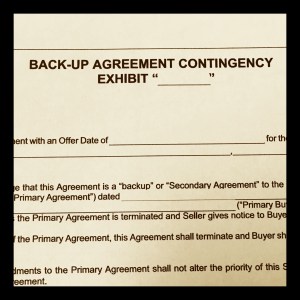
THIS is where the backup offer comes in.   When another buyer wins the property you want, you can offer to “be the backup.” What that means is that you make an offer to the seller that if the first contract falls through, you are waiting in the wings and fall into the first position without the property ever coming back onto the market.  The backup offer, of course, has no legal effect until the seller signs it – at that point, it becomes the backup contract and is basically a right of first refusal for the backup buyer.

How it works is this – if the first contract falls through, the backup comes into effect when the seller notifies the second buyer that the first contract has fallen through.

So what’s in it for the seller?  Well, if a property comes BACK on the market after being under contract, others wonder “what’s wrong with it?”  There’s a certain stigma attached to a property that’s been under contract and that contract is terminated.  This is why you will see an agent write into such a listing something like “BUYER’S FINANCING FELL THROUGH” – the idea is to signal to future buyers that the contract termination has nothing to do with anything wrong with the house.  With a backup offer, the seller doesn’t have to risk any stigma attached to coming back ON the market.

For the buyer, of course, it’s a risk free proposition if there’s a due diligence period in the contract.  Most contracts in Georgia have a seven to ten day due diligence period during which the buyer can terminate for any reason or no reason at all.  So submitting such an offer as a backup is risk free.  Even if the contract becomes primary, the buyer can decide to terminate and get earnest money returned.

So how is it effectuated?  There’s a backup agreement exhibit in the Georgia Forms that’s used.  With the exhibit, the seller can sign because they are *not* selling the same property to two different buyers – they are granting an option to the second buyer should the first contract fall through.

With the due diligence period, the second buyer is able to terminate at any time, even before the backup contract moves into first position.  Thus, the backup buyer can continue to shop for a home and if they find the perfect place, simply terminate the backup contract.


Mary Anne Walser is a licensed attorney and full-time REALTOR, serving buyers and sellers in all areas of Metro Atlanta. Her knowledge of residential real estate and her legal expertise allow her to offer great value to her clients. Mary Anne serves on the Committee that drafts and reviews the contracts utilized by all REALTORS in the State of Georgia. In addition, she is a member of the Atlanta Board of Realtors, the Georgia Association of Realtors, the State Bar of Georgia and the Georgia Association of Women Lawyers. Contact Mary Anne at 404-277-3527, or via email: maryannesellshomes@gmail.com.

Share this:

  • Click to share on Facebook (Opens in new window) Facebook
  • Click to share on LinkedIn (Opens in new window) LinkedIn
  • Click to share on X (Opens in new window) X
  • Click to email a link to a friend (Opens in new window) Email
  • Click to print (Opens in new window) Print
  • Click to share on WhatsApp (Opens in new window) WhatsApp
  • More
  • Click to share on Reddit (Opens in new window) Reddit
Like Loading...

Waving the Red Flag

05 Tuesday Apr 2016

Posted by Mary Anne Walser, REALTOR in real estate

≈ 1 Comment

Tags

buying, buying a home, buying process, real estate, resale

RED FLAG

As you prepare to give the GREEN LIGHT to the right property for you, what RED FLAGS should you look for?   Most things that are wrong with a property can be fixed by spending some or a lot of money.  Not everything can be fixed, though, and you want to go into your home purchase with eyes open.  Be sure that you are equipped to deal with anything your chosen house might have in store.

Some “red flags” are things that you can’t change about a house and which will make it more difficult to sell when YOU go to sell; identifying these tells us that if you buy that particular home, you must get a *really* good deal in order to make up for the loss in resale value on the other end.

Most “red flags” I am going to point out to you as we are looking at property.  Here are some of the things we look at carefully:

  • Sold “AS IS” with no disclosure. It’s fine if a seller wants to sell “as is”.  What that means is that they don’t want to do any repairs.  But if a seller has lived in the home, I want a disclosure.  Even if they “don’t know” the answers to all the disclosure questions, that in itself is good information.  A caveat here is if the home is an estate sale or foreclosure and the seller has never lived in or owned the home.  In that instance, I do want them to disclose anything that they do know, but there is a reason why they might not know anything about the home.  Sometimes getting a disclosure is as easy as explaining to the seller’s agent that selling a home “as is” is NOT the same as selling a home with “no disclosure”.
  • The lot slopes steeply towards the house. If the front or back yard slopes steeply toward the house, that can signal water problems in the basement or crawlspace.  Proper drainage and regrading can help ameliorate the hydrostatic pressure of ground water pushing against the house, but this type of work is usually quite costly.  What you look for here is that if there IS a slope, there is a flat area between the bottom of the slope and the house and that the water drains around the side of the house and not into the basement or crawlspace.  We also want a grade of not more than about twenty percent and that the water flow is not directed to the house, but around it.
  • Check crime maps. Now, personally I wouldn’t say that high crime in a given area should make it a “no go” because there’s crime everywhere.  A police officer explained to me once that the criminals seek out the most expensive parts of town – why wouldn’t they?  And so even a safe looking area might have lots of crime, and you want to know about it.  Is it a sudden rash of crime or a continual problem?  If there is crime in a given area, you should be looking for a much better deal than you would elsewhere and, of course, you will want a good alarm system.  There are lots of places online to check for crime and for criminals – there are sites that track all sorts of crime, and sites that map the sex offender registry.  Look at them both before you make a decision.
  • Building materials that have been the subject of class action lawsuits:
    • POLYBUTYLENE PIPES: Poly is a form of plastic resin used in plumbing supply pipes extensively during 1975-1995. An estimated one in five homes built during that time will have poly pipes.  Your inspector can typically tell you if the home has poly pipes – the supply pipe is usually grey, and if it is the main line coming into the house, blue.  What’s the problem?  Over time polybutylene pipes deteriorate from the inside, and eventually cracks form.  When you have poly pipes, you never know when they might start to leak, so it’s better to replace them pre-emptively.
    • SYNTHETIC STUCCO: Also known as EIFS (exterior insulating and finishing system), EIFS was introduced to the United States in 1969. At first, it was primarily used in commercial buildings until the 1980s, when it was introduced in the residential market.  It has superior insulating properties, but that is also the problem – the properties of the product that are designed to keep water from getting into the building envelope make it difficult for that water to get out once it does get in.  With commercial uses, the building envelope is steel or concrete.  The problem in the residential market is plywood framing, which is a problem when moisture intrudes, and improper installation.
    • L.P. SIDING: This siding was used extensively in the 1980s. Louisiana Pacific introduced this composite siding in 1985 and it was very popular until problems starting cropping up in the early 1990s. Louisiana Pacific siding is little more than excess lumber which is ground up, mixed with glue, and run through a press; this a perfect environment for fungal growth. The problematic fungus was also part of the package, as it was already present in the wood when it was ground up. Louisiana Pacific received most of the notoriety for this, but several other companies also made a similar product with similar problems.
    • ASBESTOS: Asbestos is an excellent fire retardant and insulator and so was used extensively in buildings in 1940 through 1970. It was then discovered that prolonged exposure can lead to lung cancer when the asbestos is disturbed.  Asbestos can be found in many forms – floor tiles, fiber cement siding, linoleum, roof shingles, and HVAC duct insulation.  Generally speaking, the key is to not disturb the asbestos.  The key to deciding whether it’s a red flag for your purpose is discovering where and how much of it is in the home.
  • FLOOD PLAIN. Always ask if the home is in a FLOOD PLAIN.  If you see a home that you just cannot believe is in your price range, chances are it’s in the flood plain.  There are differing levels of severity; for instance, the 100 year flood plain means that every 100 years, on average, the home will flood.  A 500 year flood plain, then, is less severe since the average is every 500 years.  But keep in mind that in 2009 Atlanta had a 500 year flood and it could happen again in our lifetimes.  In fact, FEMA (the Federal Emergency Management Agency) redrew and expanded the flood plain maps after the 2009 floods.

The key to identifying red flags and deciding if they make a given property a NO GO for you is expert advice.  Have a knowledgeable Realtor on your side and always, always, get a thorough home inspection by a certified and experienced home inspector.  Attend your inspection and ask lots of questions.  Know that properly addressed and accounted for, a red flag property could end up being a great deal for you.  What is a red flag to one buyer can be a great opportunity for someone ready willing and able to deal with the problem.


Mary Anne Walser is a licensed attorney and full-time REALTOR, serving buyers and sellers in all areas of Metro Atlanta. Her knowledge of residential real estate and her legal expertise allow her to offer great value to her clients. Mary Anne serves on the Committee that drafts and reviews the contracts utilized by all REALTORS in the State of Georgia. In addition, she is a member of the Atlanta Board of Realtors, the Georgia Association of Realtors, the State Bar of Georgia and the Georgia Association of Women Lawyers. Contact Mary Anne at 404-277-3527, or via email: maryannesellshomes@gmail.com.

Share this:

  • Click to share on Facebook (Opens in new window) Facebook
  • Click to share on LinkedIn (Opens in new window) LinkedIn
  • Click to share on X (Opens in new window) X
  • Click to email a link to a friend (Opens in new window) Email
  • Click to print (Opens in new window) Print
  • Click to share on WhatsApp (Opens in new window) WhatsApp
  • More
  • Click to share on Reddit (Opens in new window) Reddit
Like Loading...

MAKING THE OFFER

21 Monday Nov 2011

Posted by Mary Anne Walser, REALTOR in real estate

≈ 1 Comment

Tags

agent, Appraisal contingency, Broker, buy, buying, buying process, comparable properties, COMPS, Condominium Disclosure Exhibit, earnest money check, Financing contingency, GAR, Georgia Association of Realtors, home buying, how to buy, INSPECTION TIME, Lead Based Paint exhibit, offer, Plumbing disclosure, purchase, real estate, sale, Seller’s Property Disclosure, selling

Okay, so you’ve looked and looked – and you’ve found the place that you want to buy!  What happens next?  First, have your agents pull COMPS.  COMPS are comparable properties that have sold in the area recently that will help you determine the value of the home that you want to buy.  Typically we start with homes that have sold in the last three months that are within a half mile radius that are “comparable”.  If there aren’t at least three comparable properties within those parameters, we expand the search – going out to a mile and back six months…. And so on.  Your agent can be an invaluable help in determining a fair price for the home and what you should offer.

Once you’ve determined what you’d like to offer, it’s time to put TOGETHER the offer.  We do this by filling out the GAR (Georgia Association of Realtors) Form – there’s one for single family homes, and a different one for condos.  Here are the elements of the offer: 

  • Purchase price you’re offering;
  • Amount of earnest money you’re putting up – standard in Georgia is to put up at least one percent of the purchase price, so for a $500,000 property you’d put up $5,000 in earnest money);
  • Amount of closing costs you’re asking the seller to pay:
    • This must be a SPECIFIC amount.  You can’t just ask the seller to pay “all” closing costs, or 50% of closing costs – you have to ask for a specific amount
    • Make sure the amount you are asking the seller to pay is not MORE than your actual closing costs.  Your lender can help you determine this
  • What DATE you want to close.  Typically you’ll need at least three weeks from making the offer if you are getting a loan (not paying cash) for the lender to underwrite your loan;
  • Due diligence period – this should be seven to ten days, unless there is a good reason to ask for more (say there’s evidence of structural problems, that sort of thing).  During the due diligence period you can terminate for any reason or no reason at all, and still get your earnest money refunded;
  • The closing attorneys you’d like to use; your Realtor can make recommendations for this – it needs to be an attorney who regularly does closings and who in on your Lender’s approved list;

In the stipulations, here are some things (among many) you may ask for (BUT keep in mind, that you might not want to clutter up your offer with lots of ancillary requests, particularly if the offer is a lowball offer):

  • Seller to provide a one year termite bond for Buyer
  • Seller to provide a one year home warranty for Buyer
  • Seller to provide a survey of the property for Buyer
  • Seller to have the property professionally cleaned prior to closing
  • There may be certain items in the property that aren’t listed on the Seller’s Disclosure as staying with the property, but which you want to remain with the property, such as:
    • A porch swing
    • A gas grill
    • A piece of furniture that is custom fit to a certain spot
    • Chandeliers, if not already being left; etc. 

In addition, there are often EXHIBITS to the contract that are necessary: 

  • Financing contingency – if you are paying for the property with a LOAN, you want to be sure that you can obtain financing
  • Appraisal contingency – this assures that the property must appraise for the amount you are paying, or you are able to get out of the contract
  • Lead Based Paint exhibit – if the property was built prior to 1978, you need an exhibit explaining that there may be lead based paint in the property
  • Plumbing disclosure – in some counties, like Dekalb, the county requires that you have LOW FLOW fixtures in order to obtain water service.  In those counties, there should be a plumbing disclosure attached to the contract
  • Seller’s Property Disclosure – this is attached to and becomes a part of the contract
  • Condominium Disclosure Exhibit – sets forth the monthly fees for the condo, etc.

Your Realtor will need your signature on the offer and exhibits, will need the earnest money check IN HAND (the Broker will deposit the check when you’ve reached binding agreement – otherwise, it will be torn up or returned to you) and a prequalification from your lender.

Now, the game begins!  Unless you’ve made a very good offer, chances are that the Seller will counteroffer, and the counteroffers will go back and forth until the parties reach agreement.  At this point, it is INSPECTION TIME – the subject for another blog post in the near future!!!

Share this:

  • Click to share on Facebook (Opens in new window) Facebook
  • Click to share on LinkedIn (Opens in new window) LinkedIn
  • Click to share on X (Opens in new window) X
  • Click to email a link to a friend (Opens in new window) Email
  • Click to print (Opens in new window) Print
  • Click to share on WhatsApp (Opens in new window) WhatsApp
  • More
  • Click to share on Reddit (Opens in new window) Reddit
Like Loading...

  • Mary Anne Walser, REALTOR's avatar

Archives

  • June 2022 (1)
  • February 2022 (1)
  • April 2021 (1)
  • February 2021 (1)
  • August 2020 (1)
  • June 2020 (1)
  • February 2020 (1)
  • October 2019 (1)
  • January 2019 (1)
  • December 2018 (1)
  • November 2018 (1)
  • September 2018 (1)
  • August 2018 (1)
  • June 2018 (2)
  • April 2018 (1)
  • March 2018 (1)
  • February 2018 (1)
  • January 2018 (1)
  • November 2017 (1)
  • October 2017 (1)
  • September 2017 (1)
  • August 2017 (1)
  • July 2017 (1)
  • June 2017 (2)
  • February 2017 (1)
  • January 2017 (2)
  • November 2016 (2)
  • October 2016 (1)
  • September 2016 (2)
  • August 2016 (1)
  • July 2016 (1)
  • June 2016 (3)
  • May 2016 (3)
  • April 2016 (2)
  • March 2016 (1)
  • January 2016 (1)
  • December 2015 (1)
  • November 2015 (1)
  • October 2015 (2)
  • August 2015 (1)
  • June 2015 (1)
  • March 2015 (1)
  • February 2015 (2)
  • December 2014 (1)
  • August 2014 (1)
  • June 2014 (2)
  • January 2014 (3)
  • December 2013 (2)
  • September 2013 (1)
  • August 2013 (1)
  • July 2013 (2)
  • June 2013 (1)
  • April 2013 (1)
  • March 2013 (3)
  • February 2013 (3)
  • January 2013 (2)
  • November 2012 (2)
  • October 2012 (1)
  • August 2012 (2)
  • July 2012 (1)
  • May 2012 (1)
  • April 2012 (2)
  • March 2012 (3)
  • February 2012 (3)
  • January 2012 (2)
  • December 2011 (2)
  • November 2011 (3)
  • October 2011 (3)
  • September 2011 (3)
  • August 2011 (6)

Recent Posts

  • Where Sellers Go
  • 2022 A (real estate) Space Odyssey & Oddities
  • Renovate or Relocate!?
  • OWNING A PIECE OF ATLANTA HISTORY
  • Your Atlanta Pandemic Real Estate Plan

Enter your email address to subscribe to this blog and receive notifications of new posts by email.

Join 4,045 other subscribers
  • RSS - Posts
Follow Atlanta Real Estate Wisdom on WordPress.com

Mary Anne Walser, Realtor & Licensed Attorney

Keller Williams Realty
3650 Habersham Rd.
Atlanta, GA 30305
404-277-3527

Blog at WordPress.com.

  • Subscribe Subscribed
    • Atlanta Real Estate Wisdom
    • Join 82 other subscribers
    • Already have a WordPress.com account? Log in now.
    • Atlanta Real Estate Wisdom
    • Subscribe Subscribed
    • Sign up
    • Log in
    • Report this content
    • View site in Reader
    • Manage subscriptions
    • Collapse this bar
 

Loading Comments...
 

    %d