• About Real Estate Wisdom
  • Blog of Wisdom
  • Testimonials
  • Contact

Atlanta Real Estate Wisdom

~ the source for Atlanta real estate expertise

Atlanta Real Estate Wisdom

Tag Archives: buying

The Wonderful World of Atlanta Mortgage Lending

08 Thursday Sep 2016

Posted by Mary Anne Walser, REALTOR in real estate

≈ Leave a comment

Tags

atlanta, Atlanta Metro, buyer, buying, buying a home, buying process, home buyer, home buying, interest rates, lender, lending, mortgage, mortgage loan, real estate, underwriting

20160907_110905

The Wonderful World of Atlanta Mortgage Lending

Mary Anne Walser, Realtor & Attorney, 404-277-3527, maryannesellshomes@gmail.com

Tony was a first time homebuyer. He balked at my requirement that buyers be prequalified by a lender before we go out looking at property. “I don’t want to share my personal financial information,” he said. “Well,” I laughed, “welcome to the world of mortgage lending.” Not only your personal financial information, but lots of information that you think would not even be relevant to the purchase of property must be shared with strangers (the mortgage banker and staff).

I always prepare buyers for the fact that they will be asked for a LOT of information. I joke that the lender will even ask them for their third grade report card (being particularly interested in their math scores). A recent buyer – Mia – called me up laughing one day. “You remember when you said they’d ask for my third grade report card? Well, you were almost right. The lender wants my college transcripts!” Now, Mia was well out of college and fully ensconced in her current job for at least two years. But this is just an illustration that there is no telling what the lender is going to ask to see. The best I can do for you is prepare you so you aren’t surprised. Get together everything that the lender will likely need (see the list below), but then be ready that they may ask for much much more. Like your third grade report card.

Here are some of the documents you should have ready for your lender:

  • W-2 forms from the previous two years, if you collect a paycheck.
  • Profit and loss statements or 1099 forms, if you own a business or are an independent contractor.
  • Recent paycheck stubs.
  • Most recent federal tax return, and possibly the last two tax returns.
  • A complete list of your debts, such as credit cards, student loans, car loans and child support payments, along with minimum monthly payments and balances.
  • List of assets, including bank statements, mutual fund statements, real estate and automobile titles, brokerage statements and records of other investments or assets.
  • Canceled checks for your rent or mortgage payments.

This is by no means an exhaustive list. If you have had credit problems or a complicated work history, be prepared to produce even more documents. And the requests just keep coming, sometimes right up to and on the day of closing. The lender may also pull your credit report again right before closing. That’s why we tell you not to make major purchases between loan application and close. WAIT to buy your new furniture and a new car. Big purchases on credit might disqualify you for the loan because they disrupt your income/debt ratio.

So why the need for all this information, borrower laid bare before the mortgage altar? Remember that the lender is giving you a great deal of money to purchase a home. Back in 2006-2008, they were giving money much much too freely. Back then there were even what were called “stated income loans,” where the bank would pull your credit score, ask you what your income was (without any verification requirement) and give you a loan based solely on your credit and what you claimed that you made. You can see where lots of borrowers got into trouble with this. I personally saw real estate agents who I knew did not make a lot of money purchasing huge houses, thinking that they’d be able to resell them at a profit. When the homes didn’t resell, they defaulted. This happened with borrowers of all professions on a national scale – hence the mortgage meltdown.

So now things have tightened up quite a bit, and the documentation requirements are once again onerous. There’s a person called the “underwriter” who you may label the “undertaker” before all is said and done. Your loan officer gathers the preliminary information from you, then hands the file over to the underwriter, whose job it is to “underwrite” the loan. This means that they make sure it conforms with the relevant guidelines and that it is a loan that is likely to be repaid. They require any and all relevant documentation (and some that certainly seems irrelevant) to satisfy the lender that you have the ability to and will repay the loan.

So call a lender and be prepared for the onslaught of requests. Now, let’s talk about the types of lenders. You can call a direct mortgage lender or a mortgage broker – the difference is that a direct lender is lending you money they control. A mortgage broker is shopping around for a loan and is lending you someone else’s money. So a direct lender will usually have more control over the process (through the underwriter, in particular) and the mortgage broker can shop around, but will not have a lot of control over the loan once they choose one for you. I have favorite direct mortgage lenders AND favorite mortgage brokers (call me if you want a referral!) It is just a matter of finding someone experienced and fair.

Most of my buyer/borrowers these days do a 30-year conventional loan, twenty percent down. Interest rates are still so low – I definitely do NOT recommend doing an ARM (“Adjustable Rate Mortgage”). With an ARM, you have a fixed rate for some period of years – three, five or seven – and then when the ARM expires the interest rate resets to a formula based upon the prevailing rates at the time. Since interest rates are SO low now and likely to rise, you would be better off just signing up for one continuous interest rate over years. What if you think you will move before the ARM expires? The ARM rate is generally lower than the conventional loan rate, so that is tempting. But consider that you may change your mind about moving OR about selling. When I purchased my first home, I used a seven-year ARM, convinced that I would move before the seven years were up. I didn’t! But rates were lower at the seven year mark and I refinanced to a 15 year loan instead. And I still own that property (now as a rental). If rates had gone UP, I would have been quite sorry that I had chosen an ARM instead of a fixed rate mortgage.

Find a lender you know and trust, and sit down with them and talk through the wonderful world of mortgage lending and what is best for you. Then let’s go find your home!


Mary Anne Walser is a licensed attorney and full-time REALTOR, serving buyers and sellers in all areas of Metro Atlanta. Her knowledge of residential real estate and her legal expertise allow her to offer great value to her clients. Mary Anne s a member of the Atlanta Board of Realtors, the Georgia Association of Realtors, the State Bar of Georgia and the Georgia Association of Women Lawyers. Contact Mary Anne at 404-277-3527, or via email: maryannesellshomes@gmail.com.



Share this:

  • Click to share on Facebook (Opens in new window) Facebook
  • Click to share on LinkedIn (Opens in new window) LinkedIn
  • Click to share on X (Opens in new window) X
  • Click to email a link to a friend (Opens in new window) Email
  • Click to print (Opens in new window) Print
  • Click to share on WhatsApp (Opens in new window) WhatsApp
  • More
  • Click to share on Reddit (Opens in new window) Reddit
Like Loading...

Buy Land – They’re Not Making It Anymore: Investing in Atlanta Real Estate

31 Wednesday Aug 2016

Posted by Mary Anne Walser, REALTOR in real estate

≈ Leave a comment

Tags

atlanta, Atlanta market inventory, buying, CASH, condominiums, interest rates, investing, investment, real estate, renting, townhome

BUY LAND – THEY’RE NOT MAKING IT ANYMORE

INVESTING IN ATLANTA REAL ESTATE

Mary Anne Walser, Esq., Realtor 404-277-3527

It’s no secret that Atlanta is rich in real estate investment opportunity. We have experienced a steady rate of population growth and numerous large companies moving into Atlanta bringing thousands of workers with them. The only limitation to this skyrocketing growth might be TRAFFIC – although to date TRAFFIC doesn’t seem to have put the brakes on people moving to Atlanta at all. So Mark Twain’s advice to “BUY LAND, THEY’RE NOT MAKING IT ANYMORE” seems very good advice in our city where population is growing and the demand for housing ever increasing.

So say you want to diversify your portfolio a bit and invest in residential rental property. I help many do this and am asked some common questions that I thought I would compile to help guide others. So think of this as Atlanta real estate investment 101.

First, CAN you invest in rental property? The best scenario is if you have about $200,000 – $300,000 in cash that you can pay for a property. If you want to buy a reasonably priced property that is easy to rent out and likely to appreciate in a reasonably safe neighborhood, that’s about what you will need. Of course, I help plenty of investors who don’t have that much cash lying around. You can also get an investment loan. That allows you to leverage your investment and as long as you are careful not to get in over your head, given how low interest rates are right now, that’s an awesome option. The downside to getting a loan to invest in property is that investment loans carry a higher interest rate than owner occupant loans, and you will have more difficulty getting a great deal in purchasing a property because you will be competing with others who ARE making cash offers. For an investment loan, also, you will still need some cash – a minimum of twenty percent for most investment loans.

I generally suggest that investors consider single family properties rather than condos or townhomes. Most condominiums have rental restrictions under which only 25 to 30 percent of the units can be rented out at any given time. If all the rental permits are taken, you are not allowed to rent the unit. So rather than take that chance and deal with monthly homeowner dues and potential special assessments, with a single family home you have more control over your property and again – God isn’t making more land – so the land itself has greater value. The exception to this advice would be FEE SIMPLE townhomes. If you own a townhome in fee simple, there are no rental restrictions. You own the ground below the unit, the roof above it, and you are free to rent it out. Consider the neighbors, however; if they allow their property to deteriorate, it will directly effect that fee simple townhome.

Once you have determined if you have the financial wherewithal to invest and whether you want to consider single family or condo (or fee simple townhome), the next question becomes WHERE to buy. In a market downswing, there will be many options for good investment. In a more balanced market, you have to be a little more careful.  Right now, though, just about anything you can get under $250,000 that is inside the Perimeter on the North end anywhere or just outside it in Sandy Springs or Dunwoody is going to be a good purchase. I mentioned traffic – it’s not getting any better. And so close in properties are rising in value. Properties in that price range are already few and far between and will be more valuable in the future.

The other area prime for investment is anywhere near The Beltline. We have seen what The Beltline’s Eastside Trail has done for properties around it – property values have skyrocketed there! And “The Beltline effect” has already increased values along the not yet completed West and Southside Beltline Trails. However, there are still values to be had there if you’re quick, savvy and have a great agent.

So, you have narrowed down areas of town and we are out looking at investment property. How do you analyze it? The first thing we determine is your tolerance for repair. Do you want something that is ready for occupancy or something that needs work so you can build equity through labor? Of course the cost of the renovation – which is typically more than you think or originally estimate – must be taken into account.  I usually recommend that a first time investor without construction experience buy a property that is “ready to rent” without too much further work. If you do have some tolerance for renovation, carefully consider the cost in your investment equation.

In addition, it is best to find a property that will provide steady rental income AND will appreciate in value over the years. You cannot count on appreciation, so never bank on that alone – the property must bring in sufficient income to make sense as a purchase on its own whether it appreciates or not. So once we’ve identified the areas that are likely to appreciate, we consider how much income a given property will bring to you as an investor. The Capitalization Rate or “cap rate” is the ratio of the property’s net income to its purchase price and allows you as an investor to compare properties by evaluating a rate of return on that investment. Here is an example of how to calculate cap rate, using a quadraplex at a purchase price of $300,000. We have determined from examining other units rented in the area that each apartment will command $800 per month for rent. So here is how we figure the cap rate:

FIRST, CALCULATE GROSS INCOME

MONTHLY RENT = $3200 (quadraplex of 4 units rented for $800 each)

For ONE YEAR = 12 MONTHS

12 (months) X 3200 (monthly income) = $38,400 yearly gross income

SECOND, CALCULATE NET INCOME

38,400

-2,000 TAXES AND INSURANCE

-5,000 MAINTENANCE & OPERATING EXPENSES

$31,460 net income

THEN, DIVIDE THE NET INCOME BY THE PROPERTY PRICE

31,460 ÷ 300,000 = .104, or TEN PERCENT cap rate

Now, you can probably intuit the disclaimers I will put on this information. The net income can be difficult to figure as your expenses may be higher than anticipated. Maintenance can be a huge question. A property may need more repair than you know. Bad tenants and vacant units can be another pitfall – you may get a tenant who defaults or tears up the unit. There may be several months between tenants before you are able to rent it out again. (So you may decide to reduce the rental gross income by ten percent to account for potential vacancies in-between tenants).  If you do not want to self-manage your property, you should include management costs as part of your operating expenses. Finally, this cap rate example presumes a CASH purchase. If you are financing the purchase then, of course, you must include the costs of financing.

Generally, investors consider a cap rate of ten percent to be a “good” cap rate. You have to make that determination on your own, taking into account other avenues you have for investment. Investment in real estate requires some courage and not a small amount of intuition. But as far as we know, as Tony Soprano said (rephrasing Twain), God ain’t making any more land – so perhaps it is time for you to consider buying more of it!


Mary Anne Walser is a licensed attorney and full-time REALTOR, serving buyers and sellers in all areas of Metro Atlanta. Her knowledge of residential real estate and her legal expertise allow her to offer great value to her clients. Mary Anne s a member of the Atlanta Board of Realtors, the Georgia Association of Realtors, the State Bar of Georgia and the Georgia Association of Women Lawyers. Contact Mary Anne at 404-277-3527, or via email: maryannesellshomes@gmail.com.


Share this:

  • Click to share on Facebook (Opens in new window) Facebook
  • Click to share on LinkedIn (Opens in new window) LinkedIn
  • Click to share on X (Opens in new window) X
  • Click to email a link to a friend (Opens in new window) Email
  • Click to print (Opens in new window) Print
  • Click to share on WhatsApp (Opens in new window) WhatsApp
  • More
  • Click to share on Reddit (Opens in new window) Reddit
Like Loading...

Invitations to Offer & Reverse Offers – How Atlanta Home Sellers Make Offers to Buyers (instead of the other way around)

28 Thursday Jul 2016

Posted by Mary Anne Walser, REALTOR in real estate

≈ 1 Comment

Tags

atlanta, buyer, buying, buying a home, home buying, home selling, offer, real estate, seller, selling, selling a home

INVITATIONS TO OFFER & REVERSE OFFERS – how Atlanta Home Sellers make offers to Buyers (instead of the other way around)

By Mary Anne Walser, Realtor & Attorney, 404-277-3527, maryannesellshomes@gmail.com


When you LIST YOUR HOME for sale, is this an OFFER that a buyer can accept by agreeing to the terms you present? What does it take for a buyer to have a binding contract to buy a home? This surprises some people – but legally, even if you as a buyer offer list price or more for a home, it doesn’t mean the seller has to sell it to you.

By way of example, let’s say you see a home on the market for $500,000. You offer $500,000 and do not ask the seller for anything specifically, other than the property itself – it’s just a clean, straightforward offer for exactly what the seller is asking for the property. You even offer CASH and you don’t have to sell something in order to buy, so there’s no financing contingency. Do you have a contract at that point? NO. Although a lot of buyers think that it should work that way. Why is there no contract?

A binding contract requires agreement on all basic terms. A property listing – in this example, the listing that offered the property for $500,000 – is not an “offer” that can be accepted, because there are many key terms that are not present. What DATE will you close, for instance? Will there be earnest money and if so, in what amount? Is there a right to inspect? What fixtures are included with the property?

Because there is so much that must be determined between the parties other than the price, the property listing is not an “offer” that can be accepted – it is what is called an “invitation to offer.” It’s asking for buyers to make offers, but it’s not guaranteeing that the property will be sold even if the seller receives a full price offer. Indeed, many sellers purposefully price the listing at LESS than they would take because they want to start a bidding war on the property. They hope the low list price will get a buyer feeding frenzy going and that therefore the property will sell for MORE than list price.

The listing as invitation to offer isn’t the only “invitation” the seller can extend the buyer. Many sellers overlook a very powerful tool for selling their home – the reverse offer.

Here is how a reverse offer works. Say you are eager to sell your home, and a buyer has been to your home multiple times and is obviously interested, but is hesitant to make an offer. Have your agent call that buyer’s agent and find out WHY the buyer hasn’t made an offer. If there are reasons you can do something about, make an offer TO THE BUYER and get them off the fence.

Recently I had an adorable listing and one of the buyer’s agents who showed it told me that her client LOVED the home, but was about to make an offer on another home in the same neighborhood instead. “Why the other home?” I asked. There were multiple reasons. “Why NOT my listing?” I then asked, and gathered even more information.

There were some objections the buyer had that we could do nothing about. We were a smaller home than the other one they were considering. But there were some pluses we had that the other listing did not. For one thing, my listing is right across the street from the awesome neighborhood park! For a buyer with a child (as this one was) it just doesn’t get better than that. We were also better priced than the other listing. One thing the buyer did NOT like was that our floors were scratched up and well worn.

But my seller was motivated to sell and I WANTED THIS BUYER. There was a great buyer about to purchase in the very neighborhood where my listing was located. My sellers were moving out of state and really wanted to be able to go ahead and make an offer on a home in their new state – but couldn’t do so until their current home was under contract.

SO, we made a reverse offer. We offered a lower price and refinished floors PLUS my sellers wrote perhaps the best reverse offer letter in the history of reverse offers, we came down from list price a bit, and we offered to finish the floors after closing, but before the buyer moved in. Here is a revised and edited bit of my seller’s reverse offer letter, just to give you an idea of what a seller might write in this situation:

We are so thrilled that you are considering our neighborhood for your new home. It truly is a special neighborhood. Our neighbor and friend next door (to the left as you face the house) is the best neighbor you could ever ask for. He’s quiet, hosts fantastic happy hours, and is always willing to lend a hand. I’m not sure you could borrow a cup of sugar from him, but I can speak from experience that we have borrowed a bottle of wine on occasion! And I hope you took a look at the great park across the street. I understand that you have a dog – the field is an unofficial dog park where neighbors take their dogs to run and play after work and on weekends. Having the park across the street has been like an extension of our yard and we have made much use of it over the years – and I hope that you will, too.

We’d like to offer you a reduced price on the home as well as the promise to refinish the floors to a stain of your choice. We are relocating and your timeline works extremely well with our proposed summer move date. We really feel that our home would be a wonderful fit for you!

Who WOULDN’T want to buy this Seller’s home after reading that letter? And in this instance, THE REVERSE OFFER WORKED. The Buyer purchased my Seller’s home rather than the other one she was eyeing in the neighborhood.

Real estate is an art as well as a science. The key whether you are buying OR selling is to be flexible, open, and creative!


Mary Anne Walser is a licensed attorney and full-time REALTOR, serving buyers and sellers in all areas of Metro Atlanta. Her knowledge of residential real estate and her legal expertise allow her to offer great value to her clients. Mary Anne is a member of the Atlanta Board of Realtors, the Georgia Association of Realtors, the State Bar of Georgia and the Georgia Association of Women Lawyers. Contact Mary Anne at 404-277-3527, or via email: maryannesellshomes@gmail.com.


Share this:

  • Click to share on Facebook (Opens in new window) Facebook
  • Click to share on LinkedIn (Opens in new window) LinkedIn
  • Click to share on X (Opens in new window) X
  • Click to email a link to a friend (Opens in new window) Email
  • Click to print (Opens in new window) Print
  • Click to share on WhatsApp (Opens in new window) WhatsApp
  • More
  • Click to share on Reddit (Opens in new window) Reddit
Like Loading...

Waving the Red Flag

05 Tuesday Apr 2016

Posted by Mary Anne Walser, REALTOR in real estate

≈ 1 Comment

Tags

buying, buying a home, buying process, real estate, resale

RED FLAG

As you prepare to give the GREEN LIGHT to the right property for you, what RED FLAGS should you look for?   Most things that are wrong with a property can be fixed by spending some or a lot of money.  Not everything can be fixed, though, and you want to go into your home purchase with eyes open.  Be sure that you are equipped to deal with anything your chosen house might have in store.

Some “red flags” are things that you can’t change about a house and which will make it more difficult to sell when YOU go to sell; identifying these tells us that if you buy that particular home, you must get a *really* good deal in order to make up for the loss in resale value on the other end.

Most “red flags” I am going to point out to you as we are looking at property.  Here are some of the things we look at carefully:

  • Sold “AS IS” with no disclosure. It’s fine if a seller wants to sell “as is”.  What that means is that they don’t want to do any repairs.  But if a seller has lived in the home, I want a disclosure.  Even if they “don’t know” the answers to all the disclosure questions, that in itself is good information.  A caveat here is if the home is an estate sale or foreclosure and the seller has never lived in or owned the home.  In that instance, I do want them to disclose anything that they do know, but there is a reason why they might not know anything about the home.  Sometimes getting a disclosure is as easy as explaining to the seller’s agent that selling a home “as is” is NOT the same as selling a home with “no disclosure”.
  • The lot slopes steeply towards the house. If the front or back yard slopes steeply toward the house, that can signal water problems in the basement or crawlspace.  Proper drainage and regrading can help ameliorate the hydrostatic pressure of ground water pushing against the house, but this type of work is usually quite costly.  What you look for here is that if there IS a slope, there is a flat area between the bottom of the slope and the house and that the water drains around the side of the house and not into the basement or crawlspace.  We also want a grade of not more than about twenty percent and that the water flow is not directed to the house, but around it.
  • Check crime maps. Now, personally I wouldn’t say that high crime in a given area should make it a “no go” because there’s crime everywhere.  A police officer explained to me once that the criminals seek out the most expensive parts of town – why wouldn’t they?  And so even a safe looking area might have lots of crime, and you want to know about it.  Is it a sudden rash of crime or a continual problem?  If there is crime in a given area, you should be looking for a much better deal than you would elsewhere and, of course, you will want a good alarm system.  There are lots of places online to check for crime and for criminals – there are sites that track all sorts of crime, and sites that map the sex offender registry.  Look at them both before you make a decision.
  • Building materials that have been the subject of class action lawsuits:
    • POLYBUTYLENE PIPES: Poly is a form of plastic resin used in plumbing supply pipes extensively during 1975-1995. An estimated one in five homes built during that time will have poly pipes.  Your inspector can typically tell you if the home has poly pipes – the supply pipe is usually grey, and if it is the main line coming into the house, blue.  What’s the problem?  Over time polybutylene pipes deteriorate from the inside, and eventually cracks form.  When you have poly pipes, you never know when they might start to leak, so it’s better to replace them pre-emptively.
    • SYNTHETIC STUCCO: Also known as EIFS (exterior insulating and finishing system), EIFS was introduced to the United States in 1969. At first, it was primarily used in commercial buildings until the 1980s, when it was introduced in the residential market.  It has superior insulating properties, but that is also the problem – the properties of the product that are designed to keep water from getting into the building envelope make it difficult for that water to get out once it does get in.  With commercial uses, the building envelope is steel or concrete.  The problem in the residential market is plywood framing, which is a problem when moisture intrudes, and improper installation.
    • L.P. SIDING: This siding was used extensively in the 1980s. Louisiana Pacific introduced this composite siding in 1985 and it was very popular until problems starting cropping up in the early 1990s. Louisiana Pacific siding is little more than excess lumber which is ground up, mixed with glue, and run through a press; this a perfect environment for fungal growth. The problematic fungus was also part of the package, as it was already present in the wood when it was ground up. Louisiana Pacific received most of the notoriety for this, but several other companies also made a similar product with similar problems.
    • ASBESTOS: Asbestos is an excellent fire retardant and insulator and so was used extensively in buildings in 1940 through 1970. It was then discovered that prolonged exposure can lead to lung cancer when the asbestos is disturbed.  Asbestos can be found in many forms – floor tiles, fiber cement siding, linoleum, roof shingles, and HVAC duct insulation.  Generally speaking, the key is to not disturb the asbestos.  The key to deciding whether it’s a red flag for your purpose is discovering where and how much of it is in the home.
  • FLOOD PLAIN. Always ask if the home is in a FLOOD PLAIN.  If you see a home that you just cannot believe is in your price range, chances are it’s in the flood plain.  There are differing levels of severity; for instance, the 100 year flood plain means that every 100 years, on average, the home will flood.  A 500 year flood plain, then, is less severe since the average is every 500 years.  But keep in mind that in 2009 Atlanta had a 500 year flood and it could happen again in our lifetimes.  In fact, FEMA (the Federal Emergency Management Agency) redrew and expanded the flood plain maps after the 2009 floods.

The key to identifying red flags and deciding if they make a given property a NO GO for you is expert advice.  Have a knowledgeable Realtor on your side and always, always, get a thorough home inspection by a certified and experienced home inspector.  Attend your inspection and ask lots of questions.  Know that properly addressed and accounted for, a red flag property could end up being a great deal for you.  What is a red flag to one buyer can be a great opportunity for someone ready willing and able to deal with the problem.


Mary Anne Walser is a licensed attorney and full-time REALTOR, serving buyers and sellers in all areas of Metro Atlanta. Her knowledge of residential real estate and her legal expertise allow her to offer great value to her clients. Mary Anne serves on the Committee that drafts and reviews the contracts utilized by all REALTORS in the State of Georgia. In addition, she is a member of the Atlanta Board of Realtors, the Georgia Association of Realtors, the State Bar of Georgia and the Georgia Association of Women Lawyers. Contact Mary Anne at 404-277-3527, or via email: maryannesellshomes@gmail.com.

Share this:

  • Click to share on Facebook (Opens in new window) Facebook
  • Click to share on LinkedIn (Opens in new window) LinkedIn
  • Click to share on X (Opens in new window) X
  • Click to email a link to a friend (Opens in new window) Email
  • Click to print (Opens in new window) Print
  • Click to share on WhatsApp (Opens in new window) WhatsApp
  • More
  • Click to share on Reddit (Opens in new window) Reddit
Like Loading...

Investing in Atlanta Real Estate

10 Thursday Mar 2016

Posted by Mary Anne Walser, REALTOR in real estate

≈ Leave a comment

Tags

atlanta, Atlanta Metro, buying, investing, investment, real estate

A 2014 Gallup Poll shows that Americans believe that REAL ESTATE is the best investment, above stocks, mutual funds, bonds, gold, CDs or money market accounts.   I agree – with the proviso that it is the best investment only when the real estate is chosen very carefully and with expert guidance.  Here’s my “short” guide to real estate investment, with an emphasis on Atlanta.  While your primary residence can be an excellent investment, in this piece the emphasis will be on investing in real estate you do not plan to live in personally.

For many, the best approach is to buy and hold, renting out for a continuous income stream.  Some investors make great money “flipping” houses, but by and large I believe to do that well and profitably, it is best that you be well versed in building and renovation personally, and have a larger amount of time to spend overseeing the project.  So today we’ll concentrate on the investor who wants to buy and hold for some period of time.

For the first time or casual investor (i.e., the person for whom real estate investing or building, developing, or contracting is not a full time job), it is vitally important that you know what you are getting into.  Real estate is not a “passive” investment, even when you have a property manager.  It will most likely take more of your time than other sorts of investments, but it can produce wonderful returns, both monetarily and psychologically.  There is a lot to be said, for instance, for taking an unloved undervalued home and turning it into something beautiful, or choosing a property in a rundown area of town and watching it get better and better as the years go by.  Just ask anyone who is sixty years old or older here in Atlanta.  When that generation was of first time homebuying age (in their mid twenties), Virginia Highland was considered by many to be a rundown, scary area of town and not worthy of purchasing.  Those who did NOT feel that way are the extremely lucky ones who either had foresight or luck or both.  Now those homes are worth many multiples of what was paid for them back in the 1970s.

My husband and I own four rental properties, all in different neighborhoods and different areas of town.  I started with rental properties by holding onto my primary residence when my husband and I got married and bought a home together.  The home I still own is one I loved in a neighborhood that I couldn’t bear to totally leave.  Over the years, I have rented that home to a series of young professionals who have given us an excellent return while generally taking very good care of the place.  From there, for further investment properties I chose areas, communities and properties that I felt were on the “cusp” of becoming something great.

And that is how real estate investors often begin – by holding on to the property they lived in when they go to purchase their next principal residence.  Sometimes they hold onto the old because the market is down and they cannot get what they want or need from the “old” house, and sometimes they hold onto it because it can become an income producing asset.   More often, for both reasons.  And that’s a good way to start.  The home is in a neighborhood you know – and you KNOW the home; its intricacies and quirks – in short, you know what you are getting into.

But say you’re interested in exploring rental property for its own sake apart from your former residence.  Obviously, a great time to do so was in the period between 2008 and 2013 when the mortgage meltdown brought property values down across the board.  But even now that it’s a seller’s market, there are still bargains to be had – you just have to know where to look and choose carefully.

My favorite investment areas right now are the communities straddling the future West Side Beltline.  As you know, the Beltline is a 22 plus mile trail around the city core that will one day link neighborhood to neighborhood and neighbor to neighbor.  When the east side Beltline was completed just a few years ago, property values skyrocketed around the new Ponce City Market, Krog Street Market, and all the neighborhoods nearby.  Indeed, the increase has continued and today properties are being sold with multiple offers above list price – and in some instances, buyers are even taking off appraisal contingencies so that they will win in the midst of a bidding war.

I believe that the west side is poised for the same sort of growth, and it’s getting a leg up from public officials who are espousing the benefits of developing these communities.  In fact, City Council Member Mary Norwood has held bus tours of these neighborhoods to show potential investors and forward thinking city leaders the potential there.

To continue the Virginia Highland example, there are awesome examples of the same type of architecture found in that neighborhood elsewhere in Atlanta for a lot less money.   For instance, the West End and Westview have Va/Hi bungalows built at about the same time; but of course those neighborhoods did not experience the incredible growth and popularity (yet) that Va/Hi has.  In West End and Westview one can purchase one of those bungalows for less than $250,000.  The same bungalow in Va/Hi would cost $650,000 or more.

Once you identify an area of town that is ripe for investment, like the West End, how do you choose the “right” property?  You will want to calculate your ROI, or return on investment.   It’s easiest to illustrate this by example.  Say you decide to buy a property for $200,000.  Your closing costs and some basic repairs on the property cost you about $20,000.  So your cost so far is $220,000.  If you rent out that property for $2,000/monthly, you calculate your return on investment as follows:

$24,000 (yearly income) divided by $220,000 (total investment) = 0.109, or 10.9% ROI

A great return (although keep in mind that you also want to factor in taxes and insurance on the property as investment costs).

Cash is king, and many investors find it easiest to obtain great rental properties by paying cash or using private equity, but if you leverage your investment your return looks even better.  For example:

On that same deal, if I put down 20% for a down payment, my investment is only $40,000 plus closing and repair costs.  With a loan, my closing costs will be higher, so by way of example let’s say repair and closing costs are $23,000 instead of $20,000.  So I’m up to $63,000 cash out of pocket and I’m borrowing the rest.  Say I use a 30 year loan at 4.5% interest – my monthly loan payment would be $811.  If my tenant pays $2,000 a month, that nets me $1,189 monthly, and my ROI looks like this:

$14,268 divided by $63,000 = .22, or 22% ROI.  Unlike the stock market, this is a return that is regular, predictable and which gives you some control over your investment.  And there are other benefits, as John Adams recently pointed out:

  • TAX BENEFITS. You can take a loss for depreciation and apply that loss to rental income OR to regular earned income, lowering your income taxes.  Rental income is not subject to social security tax, and when sold your gain is “long term capital gain” taxes at only 20% federally and 6% in Georgia.
  • BUILDUP of EQUITY. Your tenants’ payments are helping to pay down the balance of your loan, thus increasing your net worth.  This is unique to real estate.
  • This is the tendency of real estate to increase in value over time.  Average appreciation is 4-5% per year.
  • With real estate, you are able to borrow money to buy a larger investment than you might be able to pay cash for.

Real estate can be an amazing investment.  Be sure you have the right professionals on your side, choose carefully, and go for it!


Mary Anne Walser is a licensed attorney and full-time REALTOR, serving buyers and sellers in all areas of Metro Atlanta. Her knowledge of residential real estate and her legal expertise allow her to offer great value to her clients. Mary Anne serves on the Committee that drafts and reviews the contracts utilized by all REALTORS in the State of Georgia. In addition, she is a member of the Atlanta Board of Realtors, the Georgia Association of Realtors, the State Bar of Georgia and the Georgia Association of Women Lawyers. Contact Mary Anne at 404-277-3527, or via email: maryannesellshomes@gmail.com.

Share this:

  • Click to share on Facebook (Opens in new window) Facebook
  • Click to share on LinkedIn (Opens in new window) LinkedIn
  • Click to share on X (Opens in new window) X
  • Click to email a link to a friend (Opens in new window) Email
  • Click to print (Opens in new window) Print
  • Click to share on WhatsApp (Opens in new window) WhatsApp
  • More
  • Click to share on Reddit (Opens in new window) Reddit
Like Loading...

SOME MUSINGS ON LOWER PRICE RANGES AND NEIGHBORHOODS

23 Wednesday Dec 2015

Posted by Mary Anne Walser, REALTOR in real estate

≈ 1 Comment

Tags

atlanta, Atlanta Metro, buyer, buyers, buying, home buyer, home buying, neighborhood, real estate

NeighborhoodA reporter working on a story recently contacted me and wanted me to give my opinion on the “BEST” neighborhoods for a given type of buyer in a given price range.  Unfortunately, I can’t know that without knowing the buyer.  Not only WHO you are (first time homebuyer, young family, aging empty nester), but also your personality.  Your personal traits and also your architectural personality.  Do you like historic bungalows, sleek modern houses, or traditional homes with gorgeous molding and impeccable finishes?  With any personality and price range, there are numerous neighborhoods which might fit the bill.  What you need is the Realtor who will get to know YOU and help you find the right house in the right neighborhood at the right price.  I’m going to share with you some insights I recently gave to a writer for Atlanta magazine who asked me to GENERALIZE on the best neighborhoods for a given demographic in a given price range… but keep in mind that it ALL DEPENDS ON THE BUYER.

SOME RECOMMENDED NEIGHBORHOODS for price points/demographics:

I’ll start with another disclaimer: SO MUCH depends upon where the buyer and family members WORK.  Traffic in Atlanta just gets worse and worse – and commute time is precious time away from the family.  So NO neighborhood is a good neighborhood for you if your commute time is more than an hour, I’d say!  And we have good neighborhoods all around – so I usually start by asking the homebuyer, WHERE DO YOU WORK?  And then WHERE DO YOU LIKE TO PLAY/where are your friends?  And gauge the “right” neighborhood accordingly.  Another important factor is the homebuyers’ PERSONALITY.  One may HAVE to live in a walkable neighborhood while another would prefer a newer swim/tennis community. But I will do my best giving you in a general sense some of the best neighborhoods that I think exist for each price range….

Young family
1.  Under 200k: For a young family under $200,000, believe it or not there are several very good options not too far out!  I love Doraville/Chamblee.  Montgomery Elementary School is a favorite.  If they don’t mind living farther out and commute is not an issue, $200,000 will buy you a nice home in far East Cobb.  I usually recommend that the family VISIT the school personally where their child will go.  Some schools that don’t have great scores “on paper” are well loved by some of their constituents, and if there’s an IB (international baccalaureate program), a gifted child can have a great experience even at a not as great school.
2.  200-350k: Closer in East Cobb for the schools.  While the Sope Creek district is outside the range, there are a number of other great schools just a little farther out with houses in this price range.
3.  350-500k: Oakhurst, fun, diverse, walkable, family friendly.  There are also great options in Ashford Park/Drew Valley/Brookhaven Heights.   These are neighborhoods across Peachtree to the east of Historic Brookhaven.  Ashford Park Elementary is well thought of and it’s a very central location, close to I-85 and to 400.  Dunwoody is always a favorite – close in, family friendly.
4.  500k+: I can’t say enough about Decatur, as long as your work commute isn’t terrible from there.  Everyone loves City of Decatur schools, the walkability and the city services.   A lot here depends on the personality of the family!  Inman Park history might be perfect for some (with great Mary Lin Elementary), Druid Hills serenity and history (Fernbank Elementary), or for the rising corporate executive perhaps Buckhead (although homes in 30327 are generally a young family’s “second” home).

20 something
1.  Under 200k: A 20 something could go for a small condo just about anywhere they want to be.  There are even cool places in this range in the heart of Virginia Highland, in Midtown, and in Buckhead.  But if investment is also a consideration, I’d go for Doraville/Chamblee area.  With The Assembly (mixed use) development going in where the old GM Plant was, there’s a whole lot happening in this part of town.  Another great place for investment would be the historic West End – anywhere near where the Beltline WILL be going in the coming years.  There’s some awesome housing stock – great historic bungalows! And soon enough this will be the new “hip” area of town.
2.  200-350k: Ormewood Park, Reynoldstown, Kirkwood – these are the cool areas of town near the Beltline that are still affordable.  I also like SMYRNA near the Smyrna Market Village.  With the Braves Stadium moving to Cobb County, Smyrna is far enough away to avoid traffic (and you’re able to get south without getting on I-75 from there) but close enough to benefit from the development.
3.  350-500k: If they are the Buckhead type, a cool sleek condo walkable to Buckhead action!
4.  500k+: Virginia Highland, Old Fourth Ward, Inman Park, anywhere near the Beltline!

Empty nester
1.  Under 200k: On the north end of town, Kennesaw is a good option and Kennesaw Mountain is a great place to hike and to take the grandkids.  On the east side of town, Stone Mountain has some great solid one level ranch housing that might also be perfect.
2.  200-350k: In this range, a good option might be a one level ranch close to where the kids live (if the kids are in Atlanta) or close to the neighborhood they are downsizing from (to stay in touch with friends).  Lots of great neighborhoods in Tucker and nearby; Tucker has a great small town feel but is so close in, and very warm and welcoming.
3.  350-500k: I find many empty nesters in this price range love the ACTIVE ADULT communities a little farther out of town.  These generally are designed in a 4-pod pattern; basically 4 houses joined together, each all one level with a garage.  There’s a central clubhouse and pool and the exterior maintenance is generally covered by the homeowners association.  Jim Chapman is one of the prominent builders of these communities.  They are generally pretty far outside the Perimeter – there’s one near Serenbe and several which are past Alpharetta.
4.  500k+: The place historically we see empty nesters in this price category purchase is in VININGS, because taxes in Cobb County are much lower for senior citizens (the county takes off the “school” portion of the tax).  Many empty nesters end up in one of the beautiful highrises like One Vinings Mountain and The Aberdeen or buy a Weiland townhome at Paces View with an elevator.  An added bonus is that those properties are within walking distance to the Vinings Jubilee and to many awesome restaurants.

Mary Anne Walser is a licensed attorney and full-time REALTOR, serving buyers and sellers in all areas of Metro Atlanta. Her knowledge of residential real estate and her legal expertise allow her to offer great value to her clients. Mary Anne serves on the Committee that drafts and reviews the contracts utilized by all REALTORS in the State of Georgia. In addition, she is a member of the Atlanta Board of Realtors, the Georgia Association of Realtors, the State Bar of Georgia and the Georgia Association of Women Lawyers. Contact Mary Anne at 404-277-3527, or via email: maryannesellshomes@gmail.com.


Share this:

  • Click to share on Facebook (Opens in new window) Facebook
  • Click to share on LinkedIn (Opens in new window) LinkedIn
  • Click to share on X (Opens in new window) X
  • Click to email a link to a friend (Opens in new window) Email
  • Click to print (Opens in new window) Print
  • Click to share on WhatsApp (Opens in new window) WhatsApp
  • More
  • Click to share on Reddit (Opens in new window) Reddit
Like Loading...

Buyer’s Remorse

09 Tuesday Jun 2015

Posted by Mary Anne Walser, REALTOR in real estate

≈ 1 Comment

Tags

buy, buyer, buyers, buying, due diligence, home buyer, home buying, homebuying, real estate, realtor

First Home Blues Five Tips to Prevent Buyers Remorse First Home Blues: Five Tips to Prevent Buyers Remorse

We don’t talk about it a lot, but it is real: buyer’s remorse.  That sinking feeling that you rushed too quickly into your home purchase and that it is all a big mistake.  If remorse comes during the due diligence period (during which the buyer can terminate for any reason or no reason at all), you can still terminate your contract; if it comes after that period, you cannot terminate without facing potential legal penalty.

Buyer’s remorse is not just a problem for buyers – it’s a HUGE problem for a seller.  If a home is on the market, goes under contract, and then comes BACK on the market, there is a stigma attached to the property, whether or not the contract termination was called for by any logical reason.  This stigmatizing effect is why sellers want to be as certain as possible that the buyer is NOT likely to back out.  For instance, many sellers would never accept an offer from a buyer who has not yet seen the property.  Why, you ask, would any buyer MAKE an offer without seeing the house?  Well, in these days of low inventory and few houses to choose from, buyers sometimes HAVE to make an offer without seeing it.  I recently helped buyers moving back to Atlanta from Sweden; with their three children, they didn’t want to move into a rental only to then move again when they purchased a home.  They had lived in Atlanta previously, and knew the area in which they wanted to live – so they trusted me, working with their parents, to decide on a home and get it under contract for them.  Whether or not they’ll have remorse is yet to be determined.

But buyer’s remorse may be more rampant in these times of buyers rushing into purchases because there is such low inventory.  The first advice I give is to remember that almost EVERY buyer has remorse at some stage of the process.  Despite my vast experience with the phenomenon, I myself had buyer’s remorse with the purchase of my current home.  I went through with the sale – at the urging of my husband – and it’s the absolute best home for us that I could ever find or ever imagine.  So working THROUGH the buyer’s remorse and soldiering onward to closing is sometimes the answer.

And I also suggest to buyers feeling a bit of remorse that we examine if the remorse is illusory and fleeting or based on fact and true potential pitfalls.  For that, we take the buyer’s initial wants and needs list.  Does the home they chose fit what they said they were looking for?  Is there likely to be another home in their price range that would fit those needs and wants better?  Looking at the inspection – are there problems with the home that are not fixable, or has the buyer just been spooked by routine home repair items that aren’t a big deal?

There are several scenarios where buyer’s remorse seems to fester that usually IS fleeting and should be worked through: when the negotiations with the seller have been contentious and the buyer is left not having good feelings about the seller; when the buyer keeps looking at homes online and considering other homes; and when family and co-workers plant doubt.  Remember that the seller is LEAVING the home and it will be yours; remember from our search that homes can be and usually are much different in person than they are online; and remember that the family and co-workers did not engage in the search with you and don’t know all that went into the decision (it’s typically more realistic to consult with friends who have been with you through the process).

With a careful selection process, a great inspector and a great real estate agent guiding your way, any buyer’s remorse may be a typical and passing phenomenon.  Sometimes knowing that it’s common is all a buyer needs to know to get through it.  For the seller faced with a terminating buyer, it is a good practice to let future purchasers know if the termination was based on “cold feet” rather than a true problem with the house.  Always let us know your current thoughts and concerns – armed with all information, buyers can avoid remorse, and sellers avoid a lost buyer.

Mary Anne Walser is a licensed attorney and full-time REALTOR, serving buyers and sellers in all areas of Metro Atlanta. Her knowledge of residential real estate and her legal expertise allow her to offer great value to her clients. Mary Anne serves on the Committee that drafts and reviews the contracts utilized by all REALTORS in the State of Georgia. In addition, she is a member of the Atlanta Board of Realtors, the Georgia Association of Realtors, the State Bar of Georgia and the Georgia Association of Women Lawyers. Contact Mary Anne at 404-277-3527, or via email: maryannesellshomes@gmail.com.

Share this:

  • Click to share on Facebook (Opens in new window) Facebook
  • Click to share on LinkedIn (Opens in new window) LinkedIn
  • Click to share on X (Opens in new window) X
  • Click to email a link to a friend (Opens in new window) Email
  • Click to print (Opens in new window) Print
  • Click to share on WhatsApp (Opens in new window) WhatsApp
  • More
  • Click to share on Reddit (Opens in new window) Reddit
Like Loading...

THE APPRAISAL PROBLEM

11 Monday Feb 2013

Posted by Mary Anne Walser, REALTOR in real estate

≈ Leave a comment

Tags

agent, Appraisal contingency, Atlanta market inventory, buyer, buying, comparable properties, construction, contract price, geographic radius, home, house, listings, mortgage, neighborhood, payout, property seller, real estate, realtor, school districts, sell, selling, sold, Square footage, style

Appraisal BalanceYou have probably heard this by now, but the Atlanta market, in most areas, is rapidly becoming a SELLER’S market again! We have more buyers than we have good, well-priced inventory, and as a consequence listings that are in good condition and well-priced are going quickly, sometimes with multiple bids.

Sounds great for sellers, and it is – but there is also a catch.

Almost every final purchase contract contains an appraisal contingency. The appraisal contingency states that the property must appraise at or above the contract price. If the property does NOT appraise, the buyer presents the appraisal to the seller, and the seller has the opportunity to agree to pay at the reduced appraisal price. If the seller does not agree to that, the buyer may terminate.

Here is where we often get into a big problem. By definition, appraisals are backward looking. The appraiser looks at similar properties that have sold in the recent past within a certain geographic radius. Even when the market is rapidly improving, the appraiser is bound by the sales that took place in the past. So as you can see, prices cannot rebound suddenly and quickly; the appraisal process does not allow that. Prices must rise more slowly and steadily, as appraisals must build upon homes that have already sold. Good appraisers will also research other properties currently under contract and set to close, which is helpful; but cannot completely take into account a market where suddenly there are more buyers willing to pay more for houses.

To illustrate, good well-priced homes are selling with multiple bids within days of being put on the market (or even BEFORE we list them). The contract price is often higher than the home will appraise for, so buyers are even, in some instances, agreeing to pay extra cash to pay ABOVE appraised value. There is one listing where the buyer agreed to pay $75,000 OVER the appraised price; while that is more than most buyers would be willing to cover, there are others willing to pay more than the appraisal says the property is worth.

And it’s not just home sellers who need to take this into consideration. Any homeowner who has a need to determine the current value of the property should take heed of this dynamic.  For instance, divorces. What this means is that if you are the divorcing party accepting a “payout” you may want to either wait some period of time before you agree to appraise the house for  the payout, bargain for a higher payout that might otherwise be negotiated, or provide in the settlement that there will be another appraisal in a year, having the party keeping the house pay you half of the increase in value in the home at that time.

If you are curious what your home might be worth in this market, here are some of the pertinent factors.  If you contact a Realtor, while they are not appraisers, they can pull comparable properties for you and give you an idea of what your property might be worth in this market:

  • How many beds/baths?
  • What type construction (brick, frame, vinyl or stucco?)
  • What style (two story, ranch, split level?)
  • What year was the house built?
  • Any significant upgrades or renovations and if so, what year – and a short description of what was done.
  • Parking – is there a garage or carport?  Two car?
  • Square footage of the home and acreage of the lot.
  • Neighborhood and school districts.

Armed with this information, a Realtor can help you determine whether or not your home is in a high demand area and poised to receive top dollar in this improving market. Just keep in mind that you should also have a strategy for handling the appraisal if it comes in lower than your contract price.

Share this:

  • Click to share on Facebook (Opens in new window) Facebook
  • Click to share on LinkedIn (Opens in new window) LinkedIn
  • Click to share on X (Opens in new window) X
  • Click to email a link to a friend (Opens in new window) Email
  • Click to print (Opens in new window) Print
  • Click to share on WhatsApp (Opens in new window) WhatsApp
  • More
  • Click to share on Reddit (Opens in new window) Reddit
Like Loading...

How do you know when the PRICE IS RIGHT?

06 Wednesday Feb 2013

Posted by Mary Anne Walser, REALTOR in real estate

≈ 1 Comment

Tags

agent, buying, comparable market analysis, dollar, home, house, Just Listed, list price, market, mortgage, property, real estate, right price, selling

House Price2

What’s the “right price” when you’re selling your home?  The longer your home sits on the market the less you’ll ultimately get for it, so you want to sell fast at top dollar; everyone does (and should).  How can we do that?  What’s the ultimate list price to accomplish your objective?  It’s a little trickier in the current environment, where we are low on housing inventory and it’s turning into a seller’s market.  It’s tempting to overprice.  But the key is to determine what price will draw those eager buyers and still get you top dollar for your home.  That’s where we step in.

First, remember that the list price should not be based on what you paid for the property, what you need to pay off the mortgage or what the price to rebuild the home would be today. What truly sets the right price is what a willing buyer is willing to pay RIGHT NOW and quickly, afraid that if they don’t buy it right away someone else will.  So the right list price takes into account a number of factors, including what other homes are out there that you’ll be competing with, and what’s sold recently in your neighborhood.

We do a comparable market analysis (CMA) for your property to help find this value. The CMA will compare your property to similar properties in your area that have sold in the past 6 months. This analysis takes in to consideration size, condition and improvements. Then we take a look at what is currently out there – the homes you are competing against.  Are you the best at the price you are asking?  That is what we are striving for.  You can see from the chart below that CONDITION is as much a factor as pricing.  You want to be the home that’s in the best condition at the lowest price – and that’s how you get “chosen” by a buyer.

Chart 1 - In market

In order to steal buyers’ attention from all the other listings you have to be better than the rest at the price you’ve chosen.  Listing your property as little as 10% above your determined market value will mean that that you will lose many potential buyers (according to the chart below, seventy percent!) who won’t even see your home because it’s overpriced.

Chart 2 - Triangle

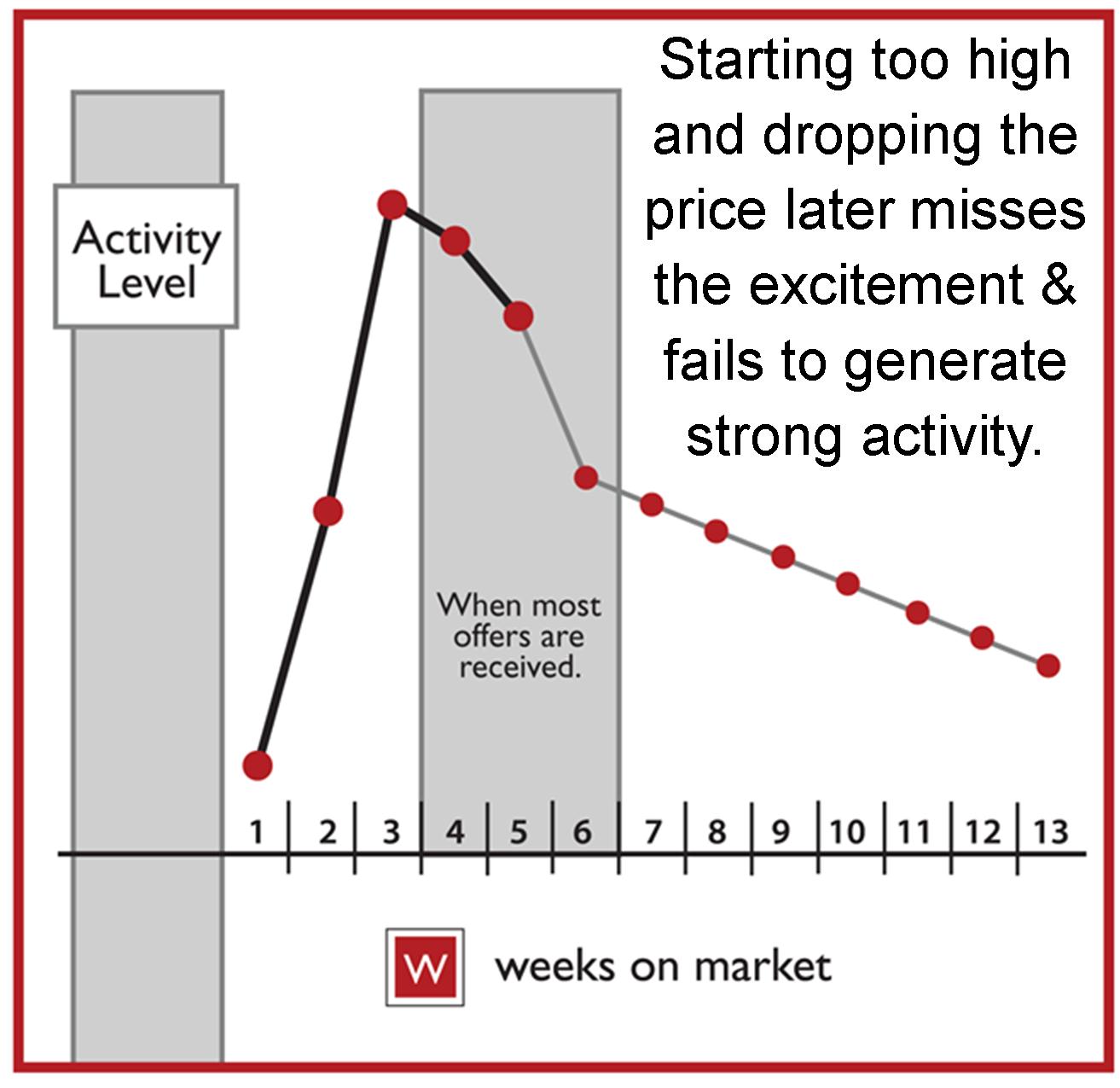
The third and last step to price your property “right” is to take FULL advantage of the first 30 days that your property is on the market. Do not fall into the trap of “trying out” an above market price for a few days just to “see if it sells”. Many sellers make this mistake and end up selling below market value. Your listing attracts the most buyers when it first hits the market. All buyers are on the lookout for “Just Listed” properties every day. If your property is listed above market value from the start, it will be missed by all those potential buyers. After even the second week of listing, property showings begin to drop.  So if you don’t have ANY showings the first two weeks, you are clearly overpriced and should drop immediately – it is already almost too late!

Chart 3 - bar graph

If you are ready to sell fast and get a great deal on your property call me today.  I will provide you with a thorough CMA specialized for your unique property so we can determine the “right” price and sell fast.

Share this:

  • Click to share on Facebook (Opens in new window) Facebook
  • Click to share on LinkedIn (Opens in new window) LinkedIn
  • Click to share on X (Opens in new window) X
  • Click to email a link to a friend (Opens in new window) Email
  • Click to print (Opens in new window) Print
  • Click to share on WhatsApp (Opens in new window) WhatsApp
  • More
  • Click to share on Reddit (Opens in new window) Reddit
Like Loading...

WHAT HAPPENS AT CLOSING?

29 Tuesday Jan 2013

Posted by Mary Anne Walser, REALTOR in real estate

≈ Leave a comment

Tags

buying, closing attorney, CLOSING STATEMENT, Good Faith Estimate, house, HUD Settlement Statement, inspection, lawyer, lender, Liens, loan closing, offer, property, real estate, realtor, selling, TITLE SEARCH

Closing Table

You have found your dream house. Made an offer, came to terms, got through inspection.  Finalized the loan and have prepared to move. Once all that is done, there’s nothing left but the final – and crucial – hour. The closing.

So what happens at this mysterious event we call “THE CLOSING”?  Many buyers are intimidated by the closing, particularly since it takes place in a lawyer’s office and involves signing page after page of legal documents. Enough to give anyone a headache.

But really, truly, you as a buyer should take a deep breath, relax, and ENJOY the closing.  Enjoy the free soft drinks and chocolate provided by the closing attorney.  Quiz the sellers about the neighbors and nearby stores and what they will miss most about the house. Laugh with your Realtor about the homes you saw that were awful (“remember that bright orange kitchen in that one house?”). Shake hands with your lender.

You can RELAX, because at this point if your Realtor and lender have done their jobs, the hard work is all done.

The closing attorney works for the lender. As a practical matter, the lender’s interests are aligned with yours, as the buyer. The closing attorney, weeks prior to the closing, ordered a TITLE SEARCH. A title search is a canvassing of the relevant county records to make sure that the seller owns the property and that there are no “liens” or claims against the property. If there are any liens, the closing attorney’s job is to clear those liens so that you are getting title to property clear and free of anyone else’s claims against it.

You don’t have to worry about any of this – because as the representative of the lender, the closing attorney has already cleared title. Pursuant to the Georgia contract, the Seller must convey clear title.  So if you’re sitting at the closing attorney’s table, title is clear. (If it’s not, the closing attorney will let all parties know and the deal will not close as scheduled until title IS clear; but typically if there is a problem you will know well in advance of the scheduled closing).

The closing attorney will first present all parties with a CLOSING STATEMENT – also known as a HUD Settlement Statement, or simply “HUD STATEMENT”.  HUD stands for Housing and Urban Development – the federal agency which mandates the form.  This and the note are the two most important documents in the closing – most if not all of the other forms are simply form documents that everyone must sign and which are the same in every closing. The HUD statement and the note are unique to you.

This is where your Realtor comes in – the Realtor represents YOU in the closing.  It’s our job to make sure the closing statement accurately reflects the financial deal between the parties.  It is a smart thing to provide your Realtor, also, with the Good Faith Estimate previously provided to you by your Lender.  The closing statement should reflect the charges in the GFE very closely (the margin of variance allowed is prescribed by law, and the closing attorney will go through with you any variance between the estimate and the actual statement).

We will check the other key document – the Note – to be sure it accurately reflects the amount of the loan, the term, the interest rate, and other terms of the loan.

There are many other pages of documents for you to sign – the Security Deed, the Truth in Lending Statement, a copy of your loan application. Most, again, are form documents – but the Truth in Lending Statement (or TIL) is worth some extra explanation here.

The TIL shows what you will pay in total over the life of the loan – adding principal and interest over the thirty years of a loan (or fifteen, if you have a fifteen year loan). It also shows a percentage – but this is very confusing.  It is NOT your interest rate. Throws buyers off all the time. It actually is your interest rate PLUS your closing costs, even if all or part of the closing costs are being paid by the Seller. Meant to be a helpful document, it’s really not. The most important thing for you to know about the TIL is that it’s not important – it’s simply for your information but must be signed. The Note and the HUD Statement govern – and they show your costs and your interest rate in a more easily understood manner.

Once you’ve signed all those documents, handed over the money you’re to bring to closing (which must be either wired or brought as certified funds), checks are cut, keys are handed over, and you own a new home!  It may seem a little anti-climatic at the time. But there’s always a big sense of relief and joy. Congratulations on your new home!

Share this:

  • Click to share on Facebook (Opens in new window) Facebook
  • Click to share on LinkedIn (Opens in new window) LinkedIn
  • Click to share on X (Opens in new window) X
  • Click to email a link to a friend (Opens in new window) Email
  • Click to print (Opens in new window) Print
  • Click to share on WhatsApp (Opens in new window) WhatsApp
  • More
  • Click to share on Reddit (Opens in new window) Reddit
Like Loading...
← Older posts

  • Mary Anne Walser, REALTOR's avatar

Archives

  • June 2022 (1)
  • February 2022 (1)
  • April 2021 (1)
  • February 2021 (1)
  • August 2020 (1)
  • June 2020 (1)
  • February 2020 (1)
  • October 2019 (1)
  • January 2019 (1)
  • December 2018 (1)
  • November 2018 (1)
  • September 2018 (1)
  • August 2018 (1)
  • June 2018 (2)
  • April 2018 (1)
  • March 2018 (1)
  • February 2018 (1)
  • January 2018 (1)
  • November 2017 (1)
  • October 2017 (1)
  • September 2017 (1)
  • August 2017 (1)
  • July 2017 (1)
  • June 2017 (2)
  • February 2017 (1)
  • January 2017 (2)
  • November 2016 (2)
  • October 2016 (1)
  • September 2016 (2)
  • August 2016 (1)
  • July 2016 (1)
  • June 2016 (3)
  • May 2016 (3)
  • April 2016 (2)
  • March 2016 (1)
  • January 2016 (1)
  • December 2015 (1)
  • November 2015 (1)
  • October 2015 (2)
  • August 2015 (1)
  • June 2015 (1)
  • March 2015 (1)
  • February 2015 (2)
  • December 2014 (1)
  • August 2014 (1)
  • June 2014 (2)
  • January 2014 (3)
  • December 2013 (2)
  • September 2013 (1)
  • August 2013 (1)
  • July 2013 (2)
  • June 2013 (1)
  • April 2013 (1)
  • March 2013 (3)
  • February 2013 (3)
  • January 2013 (2)
  • November 2012 (2)
  • October 2012 (1)
  • August 2012 (2)
  • July 2012 (1)
  • May 2012 (1)
  • April 2012 (2)
  • March 2012 (3)
  • February 2012 (3)
  • January 2012 (2)
  • December 2011 (2)
  • November 2011 (3)
  • October 2011 (3)
  • September 2011 (3)
  • August 2011 (6)

Recent Posts

  • Where Sellers Go
  • 2022 A (real estate) Space Odyssey & Oddities
  • Renovate or Relocate!?
  • OWNING A PIECE OF ATLANTA HISTORY
  • Your Atlanta Pandemic Real Estate Plan

Enter your email address to subscribe to this blog and receive notifications of new posts by email.

Join 4,045 other subscribers
  • RSS - Posts
Follow Atlanta Real Estate Wisdom on WordPress.com

Mary Anne Walser, Realtor & Licensed Attorney

Keller Williams Realty
3650 Habersham Rd.
Atlanta, GA 30305
404-277-3527

Blog at WordPress.com.

  • Subscribe Subscribed
    • Atlanta Real Estate Wisdom
    • Join 82 other subscribers
    • Already have a WordPress.com account? Log in now.
    • Atlanta Real Estate Wisdom
    • Subscribe Subscribed
    • Sign up
    • Log in
    • Report this content
    • View site in Reader
    • Manage subscriptions
    • Collapse this bar
 

Loading Comments...
 

    %d