Backup Homebuyers

Tags

, , , , , ,

FullSizeRender

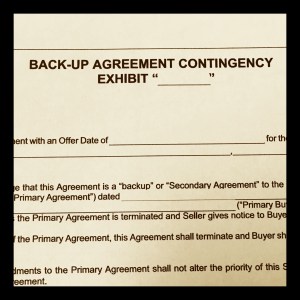
Wanna be a backup?  It’s a common question among Realtors these days.  So what are we talking about?  We have a shortage of inventory right now – not enough homes to sell for the buyers who are out there.  That means that there are often multiple offers when a hot property goes on the market.  It can be tough on the average homebuyer.  Say you have a loan, but one of the OTHER offers is all cash.  All other things being equal, cash is king and tough to beat.  Now, there are other ways to win in a multiple offer situation; perhaps money is not the only thing important to the seller.  The thing to do is to have your agent quiz the seller’s agent about what other terms would make the seller happy.  Perhaps they need a quick close – or perhaps they haven’t found a home to move to yet and need a longer close.  Maybe they need to “rent back” for some period of time.

In other instances, perhaps what is important to the Seller is bringing a great neighbor to a neighborhood they’ve known and loved.  In that instance, a letter from the buyer can make all the difference.  In fact, I recently had a client, a single mom looking for her first home purchase all on her own.  She fell in love with the “perfect” house and wrote a letter to the seller detailing all the reasons that she loved the home.  There were seven total offers on the house, and after we won the bid the listing agent told me that there were two other offers that were stronger and higher in price than ours was, but that the LETTER made the difference.  The letter touched the seller and convinced the seller that my buyer was the best buyer for the house.

But say you’ve tried the multiple offer strategies and you still lose out to another offer.  Perhaps the price went way over list and you offered less.   Maybe another buyer took out the appraisal contingency and you weren’t willing to that.  But you still loved the house.

THIS is where the backup offer comes in.   When another buyer wins the property you want, you can offer to “be the backup.” What that means is that you make an offer to the seller that if the first contract falls through, you are waiting in the wings and fall into the first position without the property ever coming back onto the market.  The backup offer, of course, has no legal effect until the seller signs it – at that point, it becomes the backup contract and is basically a right of first refusal for the backup buyer.

How it works is this – if the first contract falls through, the backup comes into effect when the seller notifies the second buyer that the first contract has fallen through.

So what’s in it for the seller?  Well, if a property comes BACK on the market after being under contract, others wonder “what’s wrong with it?”  There’s a certain stigma attached to a property that’s been under contract and that contract is terminated.  This is why you will see an agent write into such a listing something like “BUYER’S FINANCING FELL THROUGH” – the idea is to signal to future buyers that the contract termination has nothing to do with anything wrong with the house.  With a backup offer, the seller doesn’t have to risk any stigma attached to coming back ON the market.

For the buyer, of course, it’s a risk free proposition if there’s a due diligence period in the contract.  Most contracts in Georgia have a seven to ten day due diligence period during which the buyer can terminate for any reason or no reason at all.  So submitting such an offer as a backup is risk free.  Even if the contract becomes primary, the buyer can decide to terminate and get earnest money returned.

So how is it effectuated?  There’s a backup agreement exhibit in the Georgia Forms that’s used.  With the exhibit, the seller can sign because they are *not* selling the same property to two different buyers – they are granting an option to the second buyer should the first contract fall through.

With the due diligence period, the second buyer is able to terminate at any time, even before the backup contract moves into first position.  Thus, the backup buyer can continue to shop for a home and if they find the perfect place, simply terminate the backup contract.


Mary Anne Walser is a licensed attorney and full-time REALTOR, serving buyers and sellers in all areas of Metro Atlanta. Her knowledge of residential real estate and her legal expertise allow her to offer great value to her clients. Mary Anne serves on the Committee that drafts and reviews the contracts utilized by all REALTORS in the State of Georgia. In addition, she is a member of the Atlanta Board of Realtors, the Georgia Association of Realtors, the State Bar of Georgia and the Georgia Association of Women Lawyers. Contact Mary Anne at 404-277-3527, or via email: maryannesellshomes@gmail.com.
BUYER’S BROKERAGE in ATLANTA and WHAT IT MEANS

Tags

, , , ,

buyer brokerage

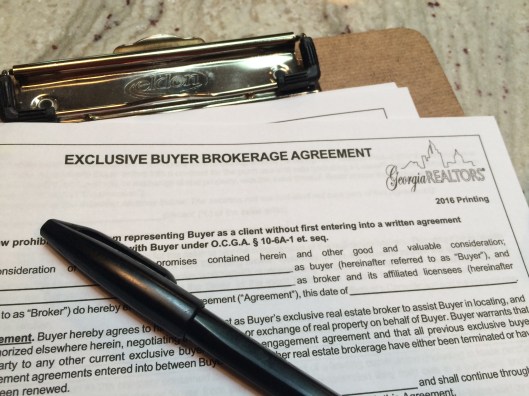
Signing legal contracts.  Not on most people’s list of favorite things to do, but in a real estate transaction you will sign many contracts leading up to and during the closing.  In Georgia, we use form documents drafted and provided to us by the Georgia Association of Realtors.  There are individual modifications that may be made, but for the most part they are “forms”.  The first form a home buyer will encounter is the Buyer Brokerage Agreement.

Let’s take a look at what it is and what it means.  The first thing to note is that it’s an “exclusive” buyer’s brokerage agreement.  That means that you are only entering into such an agreement with one Realtor; you cannot enter into multiple “exclusive” agreements.  The form explicitly states that if you have entered into other such agreements, they must be expired or you must terminate them – in other words, you are representing that they are no longer in force.  (There is also a NON-Exclusive Buyer Brokerage Agreement, but most Realtors will work with you on a continuing basis only if you have agreed to work with them exclusively).

While the contract refers to “Broker” it also relates to the individual Realtor.  We Realtors are agents working under a Broker – and so when there is reference in the contract to “Broker” you can also read that as “Realtor” or agent, and those terms are used interchangeably in this article.

You will see that the agreement also states that Georgia Law, code section 10-6A-1, prohibits a Broker from representing a buyer without this agreement in place.  Therefore, before I place on offer on your behalf, I must have this brokerage agreement signed.  Otherwise I cannot act as your agent.  There’s also a “term” to the agreement.  After the ending date, the parties are no longer bound by the agreement.  But even before the end date in the contract the agreement may be terminated by either party simply by written notice to the other.  If that happens, your only obligation as a buyer would be to notify the Agent if you purchase a property you have viewed with or through the Agent so that they can collect a commission on that property.

The agreement obligates the Broker to attempt to identify properties for Buyer to purchase.  Note the word “attempt”.  Sometimes the Buyer themselves will find a property either online or by driving by; but a Buyer under a Buyer’s Brokerage Agreement is still obligated to go through the Buyer’s Broker to see, consider, and make an offer on that property.  It’s important to note that identifying a property to purchase is not the Buyer’s Broker’s only or even sole obligation.  The Buyer’s Broker has a fiduciary duty to protect the Buyer’s interest during the process of purchasing a home.  Identifying the property to purchase is only one small step in that process.

While obligated to make all disclosures “required by law”, the Realtor is expressly NOT allowed to make representations with respect to the race, color, religion, national origin, sex, familial status, disability, sexual orientation or gender identity of a given neighborhood or community.  Notice that AGE is not mentioned in this paragraph.  In certain instances, it is all right for Brokers to talk about age restricted communities.  For instance, there are “active adult” communities in which residents must be over the age of 55.

What about liability for commission?  In Georgia, the Seller pays commissions of both agents – the listing agent and the buyer’s agent.  This obligation is contained in the form listing agreement signed by Sellers and is reflected in the Buyer Brokerage Agreement, under which the buyer is not obligated to pay a commission ever unless expressly set forth in the buyer’s brokerage agreement, or if a FSBO, or For Sale By Owner, refuses to pay the Buyer’s Agent.

The Agreement also provides for dual and designated agency.  Designated agency is common and occurs when two Realtors working for the same Broker are both working on a deal, one representing the buyer and the other representing the seller.  Generally there is no cause for concern, since both agents are obligated to protect their party’s best interest.  But what about when only ONE agent is involved?   It is not impossible for the Listing/Selling Agent to represent the buyer as well as the seller. The type of relationship created here is known as a dual agency and as long as the Listing/Selling Agent fully discloses the dual agency and obtains the written consent of both parties, he or she may represent both the seller and the buyer.

Georgia law provides very specific and strict disclosure of the nature of the dual agent’s role and deals harshly with agents who do not follow the prescriptions, including a description of the types of transactions involved, a statement that the agent will be representing parties whose interests are potentially adverse, that all material information will be disclosed to both parties, and that the client voluntarily consents to the dual agency.

The Buyer Brokerage Agreement, like many real estate forms in Georgia, contains an arbitration provision requiring the parties to arbitrate any disputes arising from the contract.   It also mentions several consumer protection brochures that should also be provided to the buyer:” Protect Yourself When Buying a Home” and “What Buyers Should Know About Flood Hazard Areas and Flood Insurance”.

When you have signed a Buyer Brokerage Agreement, you are embarking on a mutual adventure with your Realtor.  You not indentured to that agent, and if things are not proceeding as you wish there is no shame in terminating the Agreement; but first see if you can work things out with your Agent by letting them know what you need and what you feel you are missing.  Home buying is a life changing process and you need a committed advocate on your side!


Mary Anne Walser is a licensed attorney and full-time REALTOR, serving buyers and sellers in all areas of Metro Atlanta. Her knowledge of residential real estate and her legal expertise allow her to offer great value to her clients. Mary Anne serves on the Committee that drafts and reviews the contracts utilized by all REALTORS in the State of Georgia. In addition, she is a member of the Atlanta Board of Realtors, the Georgia Association of Realtors, the State Bar of Georgia and the Georgia Association of Women Lawyers. Contact Mary Anne at 404-277-3527, or via email: maryannesellshomes@gmail.com.


Mistakes Atlanta Homebuyers Make

Tags

, , , , , ,

House-flying money

Don’t look at homes you cannot afford. Many buyers make the mistake of not knowing how much they can comfortably afford in advance and wind up looking at homes that they ultimately can’t get. While that would seem to be harmless, it’s really not – if you’re looking at more expensive homes to begin with, you’ll be disappointed by the homes you actually CAN afford.

Which brings us naturally to another common mistake – don’t have unrealistic expectations. If you’ve started out looking at more expensive homes, you’ll start to expect some of those features, even if you can’t afford them. Know your price range, and then know what you can buy and where you can find it. With a small budget, you won’t be able to buy a big home in the most popular neighborhoods. I find that Zillow has helped us in this regard: homebuyers now can see, before I’m even consulted, how much homes cost in a given neighborhood.

Get caught up, but not TOO caught up, in resale value. If you don’t need a great school district, don’t buy a home just because it is in a great school district – you don’t need it.  And school districts change – boundaries and quality both change. So the great school district today might not be the best in five years. Conversely, an up and coming school district could be your best buy. And remember, your home is where you are going to live. Just because you can get a great deal in a bad area of town doesn’t mean you want to live there.

Sometimes buyers get too caught up in worrying about what OTHER buyers want. Consider what YOU want and find it. IF that’s what you are looking for, there are and certainly will be others like you out there to purchase it when you’re ready to sell.

Exceptions here are the tough resale items noted in my last blog post on “red flags.” If you fall in love with a red flag home, fine – just know that your price should take into account the fact that the home will be tougher to resell. But also keep in mind that the serious but FIXABLE problem can be your absolute best value when purchasing a home.

Finally, don’t think you can do it on your own. In Georgia, the Seller pays both agents’ commissions. A good buyer’s agent can save you time and money and negotiate expertly on your behalf, and more than pay for themselves. Your home will be one of the largest investments you will ever make – hire an expert to help!


Mary Anne Walser is a licensed attorney and full-time REALTOR, serving buyers and sellers in all areas of Metro Atlanta. Her knowledge of residential real estate and her legal expertise allow her to offer great value to her clients. Mary Anne serves on the Committee that drafts and reviews the contracts utilized by all REALTORS in the State of Georgia. In addition, she is a member of the Atlanta Board of Realtors, the Georgia Association of Realtors, the State Bar of Georgia and the Georgia Association of Women Lawyers. Contact Mary Anne at 404-277-3527, or via email: maryannesellshomes@gmail.com.

Waving the Red Flag

Tags

, , , ,

RED FLAG

As you prepare to give the GREEN LIGHT to the right property for you, what RED FLAGS should you look for?   Most things that are wrong with a property can be fixed by spending some or a lot of money.  Not everything can be fixed, though, and you want to go into your home purchase with eyes open.  Be sure that you are equipped to deal with anything your chosen house might have in store.

Some “red flags” are things that you can’t change about a house and which will make it more difficult to sell when YOU go to sell; identifying these tells us that if you buy that particular home, you must get a *really* good deal in order to make up for the loss in resale value on the other end.

Most “red flags” I am going to point out to you as we are looking at property.  Here are some of the things we look at carefully:

  • Sold “AS IS” with no disclosure. It’s fine if a seller wants to sell “as is”.  What that means is that they don’t want to do any repairs.  But if a seller has lived in the home, I want a disclosure.  Even if they “don’t know” the answers to all the disclosure questions, that in itself is good information.  A caveat here is if the home is an estate sale or foreclosure and the seller has never lived in or owned the home.  In that instance, I do want them to disclose anything that they do know, but there is a reason why they might not know anything about the home.  Sometimes getting a disclosure is as easy as explaining to the seller’s agent that selling a home “as is” is NOT the same as selling a home with “no disclosure”.
  • The lot slopes steeply towards the house. If the front or back yard slopes steeply toward the house, that can signal water problems in the basement or crawlspace.  Proper drainage and regrading can help ameliorate the hydrostatic pressure of ground water pushing against the house, but this type of work is usually quite costly.  What you look for here is that if there IS a slope, there is a flat area between the bottom of the slope and the house and that the water drains around the side of the house and not into the basement or crawlspace.  We also want a grade of not more than about twenty percent and that the water flow is not directed to the house, but around it.
  • Check crime maps. Now, personally I wouldn’t say that high crime in a given area should make it a “no go” because there’s crime everywhere.  A police officer explained to me once that the criminals seek out the most expensive parts of town – why wouldn’t they?  And so even a safe looking area might have lots of crime, and you want to know about it.  Is it a sudden rash of crime or a continual problem?  If there is crime in a given area, you should be looking for a much better deal than you would elsewhere and, of course, you will want a good alarm system.  There are lots of places online to check for crime and for criminals – there are sites that track all sorts of crime, and sites that map the sex offender registry.  Look at them both before you make a decision.
  • Building materials that have been the subject of class action lawsuits:
    • POLYBUTYLENE PIPES: Poly is a form of plastic resin used in plumbing supply pipes extensively during 1975-1995. An estimated one in five homes built during that time will have poly pipes.  Your inspector can typically tell you if the home has poly pipes – the supply pipe is usually grey, and if it is the main line coming into the house, blue.  What’s the problem?  Over time polybutylene pipes deteriorate from the inside, and eventually cracks form.  When you have poly pipes, you never know when they might start to leak, so it’s better to replace them pre-emptively.
    • SYNTHETIC STUCCO: Also known as EIFS (exterior insulating and finishing system), EIFS was introduced to the United States in 1969. At first, it was primarily used in commercial buildings until the 1980s, when it was introduced in the residential market.  It has superior insulating properties, but that is also the problem – the properties of the product that are designed to keep water from getting into the building envelope make it difficult for that water to get out once it does get in.  With commercial uses, the building envelope is steel or concrete.  The problem in the residential market is plywood framing, which is a problem when moisture intrudes, and improper installation.
    • L.P. SIDING: This siding was used extensively in the 1980s. Louisiana Pacific introduced this composite siding in 1985 and it was very popular until problems starting cropping up in the early 1990s. Louisiana Pacific siding is little more than excess lumber which is ground up, mixed with glue, and run through a press; this a perfect environment for fungal growth. The problematic fungus was also part of the package, as it was already present in the wood when it was ground up. Louisiana Pacific received most of the notoriety for this, but several other companies also made a similar product with similar problems.
    • ASBESTOS: Asbestos is an excellent fire retardant and insulator and so was used extensively in buildings in 1940 through 1970. It was then discovered that prolonged exposure can lead to lung cancer when the asbestos is disturbed.  Asbestos can be found in many forms – floor tiles, fiber cement siding, linoleum, roof shingles, and HVAC duct insulation.  Generally speaking, the key is to not disturb the asbestos.  The key to deciding whether it’s a red flag for your purpose is discovering where and how much of it is in the home.
  • FLOOD PLAIN. Always ask if the home is in a FLOOD PLAIN.  If you see a home that you just cannot believe is in your price range, chances are it’s in the flood plain.  There are differing levels of severity; for instance, the 100 year flood plain means that every 100 years, on average, the home will flood.  A 500 year flood plain, then, is less severe since the average is every 500 years.  But keep in mind that in 2009 Atlanta had a 500 year flood and it could happen again in our lifetimes.  In fact, FEMA (the Federal Emergency Management Agency) redrew and expanded the flood plain maps after the 2009 floods.

The key to identifying red flags and deciding if they make a given property a NO GO for you is expert advice.  Have a knowledgeable Realtor on your side and always, always, get a thorough home inspection by a certified and experienced home inspector.  Attend your inspection and ask lots of questions.  Know that properly addressed and accounted for, a red flag property could end up being a great deal for you.  What is a red flag to one buyer can be a great opportunity for someone ready willing and able to deal with the problem.


Mary Anne Walser is a licensed attorney and full-time REALTOR, serving buyers and sellers in all areas of Metro Atlanta. Her knowledge of residential real estate and her legal expertise allow her to offer great value to her clients. Mary Anne serves on the Committee that drafts and reviews the contracts utilized by all REALTORS in the State of Georgia. In addition, she is a member of the Atlanta Board of Realtors, the Georgia Association of Realtors, the State Bar of Georgia and the Georgia Association of Women Lawyers. Contact Mary Anne at 404-277-3527, or via email: maryannesellshomes@gmail.com.

Investing in Atlanta Real Estate

Tags

, , , , ,

A 2014 Gallup Poll shows that Americans believe that REAL ESTATE is the best investment, above stocks, mutual funds, bonds, gold, CDs or money market accounts.   I agree – with the proviso that it is the best investment only when the real estate is chosen very carefully and with expert guidance.  Here’s my “short” guide to real estate investment, with an emphasis on Atlanta.  While your primary residence can be an excellent investment, in this piece the emphasis will be on investing in real estate you do not plan to live in personally.

For many, the best approach is to buy and hold, renting out for a continuous income stream.  Some investors make great money “flipping” houses, but by and large I believe to do that well and profitably, it is best that you be well versed in building and renovation personally, and have a larger amount of time to spend overseeing the project.  So today we’ll concentrate on the investor who wants to buy and hold for some period of time.

For the first time or casual investor (i.e., the person for whom real estate investing or building, developing, or contracting is not a full time job), it is vitally important that you know what you are getting into.  Real estate is not a “passive” investment, even when you have a property manager.  It will most likely take more of your time than other sorts of investments, but it can produce wonderful returns, both monetarily and psychologically.  There is a lot to be said, for instance, for taking an unloved undervalued home and turning it into something beautiful, or choosing a property in a rundown area of town and watching it get better and better as the years go by.  Just ask anyone who is sixty years old or older here in Atlanta.  When that generation was of first time homebuying age (in their mid twenties), Virginia Highland was considered by many to be a rundown, scary area of town and not worthy of purchasing.  Those who did NOT feel that way are the extremely lucky ones who either had foresight or luck or both.  Now those homes are worth many multiples of what was paid for them back in the 1970s.

My husband and I own four rental properties, all in different neighborhoods and different areas of town.  I started with rental properties by holding onto my primary residence when my husband and I got married and bought a home together.  The home I still own is one I loved in a neighborhood that I couldn’t bear to totally leave.  Over the years, I have rented that home to a series of young professionals who have given us an excellent return while generally taking very good care of the place.  From there, for further investment properties I chose areas, communities and properties that I felt were on the “cusp” of becoming something great.

And that is how real estate investors often begin – by holding on to the property they lived in when they go to purchase their next principal residence.  Sometimes they hold onto the old because the market is down and they cannot get what they want or need from the “old” house, and sometimes they hold onto it because it can become an income producing asset.   More often, for both reasons.  And that’s a good way to start.  The home is in a neighborhood you know – and you KNOW the home; its intricacies and quirks – in short, you know what you are getting into.

But say you’re interested in exploring rental property for its own sake apart from your former residence.  Obviously, a great time to do so was in the period between 2008 and 2013 when the mortgage meltdown brought property values down across the board.  But even now that it’s a seller’s market, there are still bargains to be had – you just have to know where to look and choose carefully.

My favorite investment areas right now are the communities straddling the future West Side Beltline.  As you know, the Beltline is a 22 plus mile trail around the city core that will one day link neighborhood to neighborhood and neighbor to neighbor.  When the east side Beltline was completed just a few years ago, property values skyrocketed around the new Ponce City Market, Krog Street Market, and all the neighborhoods nearby.  Indeed, the increase has continued and today properties are being sold with multiple offers above list price – and in some instances, buyers are even taking off appraisal contingencies so that they will win in the midst of a bidding war.

I believe that the west side is poised for the same sort of growth, and it’s getting a leg up from public officials who are espousing the benefits of developing these communities.  In fact, City Council Member Mary Norwood has held bus tours of these neighborhoods to show potential investors and forward thinking city leaders the potential there.

To continue the Virginia Highland example, there are awesome examples of the same type of architecture found in that neighborhood elsewhere in Atlanta for a lot less money.   For instance, the West End and Westview have Va/Hi bungalows built at about the same time; but of course those neighborhoods did not experience the incredible growth and popularity (yet) that Va/Hi has.  In West End and Westview one can purchase one of those bungalows for less than $250,000.  The same bungalow in Va/Hi would cost $650,000 or more.

Once you identify an area of town that is ripe for investment, like the West End, how do you choose the “right” property?  You will want to calculate your ROI, or return on investment.   It’s easiest to illustrate this by example.  Say you decide to buy a property for $200,000.  Your closing costs and some basic repairs on the property cost you about $20,000.  So your cost so far is $220,000.  If you rent out that property for $2,000/monthly, you calculate your return on investment as follows:

$24,000 (yearly income) divided by $220,000 (total investment) = 0.109, or 10.9% ROI

A great return (although keep in mind that you also want to factor in taxes and insurance on the property as investment costs).

Cash is king, and many investors find it easiest to obtain great rental properties by paying cash or using private equity, but if you leverage your investment your return looks even better.  For example:

On that same deal, if I put down 20% for a down payment, my investment is only $40,000 plus closing and repair costs.  With a loan, my closing costs will be higher, so by way of example let’s say repair and closing costs are $23,000 instead of $20,000.  So I’m up to $63,000 cash out of pocket and I’m borrowing the rest.  Say I use a 30 year loan at 4.5% interest – my monthly loan payment would be $811.  If my tenant pays $2,000 a month, that nets me $1,189 monthly, and my ROI looks like this:

$14,268 divided by $63,000 = .22, or 22% ROI.  Unlike the stock market, this is a return that is regular, predictable and which gives you some control over your investment.  And there are other benefits, as John Adams recently pointed out:

  • TAX BENEFITS. You can take a loss for depreciation and apply that loss to rental income OR to regular earned income, lowering your income taxes.  Rental income is not subject to social security tax, and when sold your gain is “long term capital gain” taxes at only 20% federally and 6% in Georgia.
  • BUILDUP of EQUITY. Your tenants’ payments are helping to pay down the balance of your loan, thus increasing your net worth.  This is unique to real estate.
  • This is the tendency of real estate to increase in value over time.  Average appreciation is 4-5% per year.
  • With real estate, you are able to borrow money to buy a larger investment than you might be able to pay cash for.

Real estate can be an amazing investment.  Be sure you have the right professionals on your side, choose carefully, and go for it!


Mary Anne Walser is a licensed attorney and full-time REALTOR, serving buyers and sellers in all areas of Metro Atlanta. Her knowledge of residential real estate and her legal expertise allow her to offer great value to her clients. Mary Anne serves on the Committee that drafts and reviews the contracts utilized by all REALTORS in the State of Georgia. In addition, she is a member of the Atlanta Board of Realtors, the Georgia Association of Realtors, the State Bar of Georgia and the Georgia Association of Women Lawyers. Contact Mary Anne at 404-277-3527, or via email: maryannesellshomes@gmail.com.

Staging to Stay

Tags

, , , , , , ,

Staging

As a Realtor, I help people sell and buy homes… but today I’m going to talk about staying IN your home.  Since most of you will sell or buy sometime in the next 5 to 7 years, today most of you are probably planning to stay where you are for the time being.  If you’re not, call me immediately and let’s sell your home!  But if you’re not planning to move in the very near future, what I’m telling you today will help you regardless.

When I go on a listing appointment with a potential seller, sometimes the house is perfect for selling.  Perfectly staged and ready to go.  You know the home – the one that looks like it belongs in House Beautiful or in the pages of Dwell.  But this is the exception rather than the rule.  If I can come in, get the listing agreement signed, have the pictures taken and get the listing in the system right away, that’s marvelous – but more often there’s work that needs to be done.  And often after the work is done, the seller will tell me that they wish they had done the work long before OR that they now don’t want to move!

SO let’s talk about the advice I’m going to give you when you go to SELL your home – if you do these things now you’ll be way ahead of the game and when you’re ready to really sell, you won’t have as much work to do; if you plan to stay, you’re going to LOVE your home all the more.

  1. CURB APPEAL. It’s everything when you go to sell – the first impression of your home is the most important.  So spend some money on landscaping and make sure you keep it up (this means an irrigation system if you don’t plan to water your plants yourself).  Don’t have too much “stuff” in the form of yard art and the like.  This will be a common theme as we move inside.  While we are out here, keep these in mind:
    1. A fresh coat of paint goes a long way in terms of curb appeal. A home’s exterior should be repainted every 7 years or so.
    2. A new welcome mat IS welcoming. And not that expensive.  Spring for a welcome mat you love.
    3. Consider adding seating somewhere in the front yard – some place welcoming, a place to rest, a place to enjoy the yard. You will meet a lot more neighbors if you hang out in your front yard!
    4. Along those same lines, if you have a front porch, use it! You’d be surprised how many people have awesome front porches and don’t use them.  For a small front porch, a small cafe table and chairs will do wonders.
  1. CLEAR THE CLUTTER. Moving inside, remember that most of us have way too many “things” for comfort.   Clearing your possessions also helps to clear your mind, as pointed out by that great NY Times bestseller “The Life Changing Magic of Tidying Up”.  Because so much of it is relevant to real estate, it’s worth mentioning here:
    1. Only keep things that are useful and which you love. If it’s in a box that you haven’t opened or unpacked in more than a year, chances are you never will and it needs to GO.  Same with clothes!  I recommend a rotation system.  When an item of clothing comes to the front of your closet, you either wear it or donate it.  After it’s worn, it goes to the back. This way you avoid the trap many fall into of wearing the same thing over and over and over and never wearing half of your closet.
    2. The general rule for closets is that they should be HALF full with NOTHING on the floor whatsoever and if there are shelves, nothing folded on the shelves. Instead, use baskets and put extra items in there.
    3. Visual clutter kills a sale, and it makes you feel unorganized and unfocused. The best thing to do is to CLEAR EVERYTHING off horizontal surfaces – that is, from shelves and bookcases and tabletops, then come back and put only a few items back.  Ideally, your home should feel a little sparse to you.  Believe me, you’ll get used to it and you’ll love it.
    4. Much of the psychological difficulty about getting rid of stuff, I find, is that people don’t want to WASTE things. But you don’t have to THROW THINGS AWAY.  Give them to Goodwill.  Make it a goal to go to Goodwill with a bag of items at least once every two weeks until you feel you have clutter under control.
    5. Clearing clutter includes FOOD. How many of the items in your pantry are EXPIRED?  I am guilty of this, and after my son-in-law pointed out a few expiration dates, I went to work clearing out pantry and fridge.  It feels marvelous!
  1. TAKE PICTURES. My stager, after she’s met with my sellers and given a list of things for them to do which includes enhancing curb appeal and clearing the clutter, recommends that they go around their home with a camera or their iPhone and take pictures of each room from multiple angles.  Do this!  Then go back and take a close look at the pictures you’ve taken.  There will be lots of things you don’t notice with your straight eyesight that will pop out in a picture.  There are many reasons for this, but among them that you are USED to seeing your own home.  Seeing your home through a camera lens gives you a new perspective and you’ll notice things you wouldn’t otherwise, like cords that add visual clutter.  Taking pictures will give you a whole new perspective.
  1. REPAIR LIST. This is less visible, but an important part of making your home wonderful for yourself!  Keep a list of all those “little” repairs that need to be done.  You know – the ones that you notice only at certain times but which always bother you when you notice them.  The door that sticks; the drawer that doesn’t close all the way; the dimmer switch that heats up too much; the wood rot on the exterior.  It’s well worth your investment to hire a handyman at least two times a year to take care of this stuff.  Most of them will charge you by the hour plus materials.  And while you’re at it you can have them change the lightbulbs you have trouble changing or install that new light fixture you’ve been eyeing at Home Depot.  If buyers see a stuck door or dripping faucet, they are going to wonder if the home is well cared for and will be looking for other “problems.”  You want them focused on what’s RIGHT with the house.  The same goes for you!

That’s just a start of things I suggest for “staging to stay”.  In a future blog post, I will cover renovations – how to plan renovations that will pay off when you go to sell, but will increase your enjoyment of your home in the interim.  And never hesitate to call me, your Realtor, for advice and counsel.


Mary Anne Walser is a licensed attorney and full-time REALTOR, serving buyers and sellers in all areas of Metro Atlanta. Her knowledge of residential real estate and her legal expertise allow her to offer great value to her clients. Mary Anne serves on the Committee that drafts and reviews the contracts utilized by all REALTORS in the State of Georgia. In addition, she is a member of the Atlanta Board of Realtors, the Georgia Association of Realtors, the State Bar of Georgia and the Georgia Association of Women Lawyers. Contact Mary Anne at 404-277-3527, or via email: maryannesellshomes@gmail.com.

SOME MUSINGS ON LOWER PRICE RANGES AND NEIGHBORHOODS

Tags

, , , , , , , ,

NeighborhoodA reporter working on a story recently contacted me and wanted me to give my opinion on the “BEST” neighborhoods for a given type of buyer in a given price range.  Unfortunately, I can’t know that without knowing the buyer.  Not only WHO you are (first time homebuyer, young family, aging empty nester), but also your personality.  Your personal traits and also your architectural personality.  Do you like historic bungalows, sleek modern houses, or traditional homes with gorgeous molding and impeccable finishes?  With any personality and price range, there are numerous neighborhoods which might fit the bill.  What you need is the Realtor who will get to know YOU and help you find the right house in the right neighborhood at the right price.  I’m going to share with you some insights I recently gave to a writer for Atlanta magazine who asked me to GENERALIZE on the best neighborhoods for a given demographic in a given price range… but keep in mind that it ALL DEPENDS ON THE BUYER.
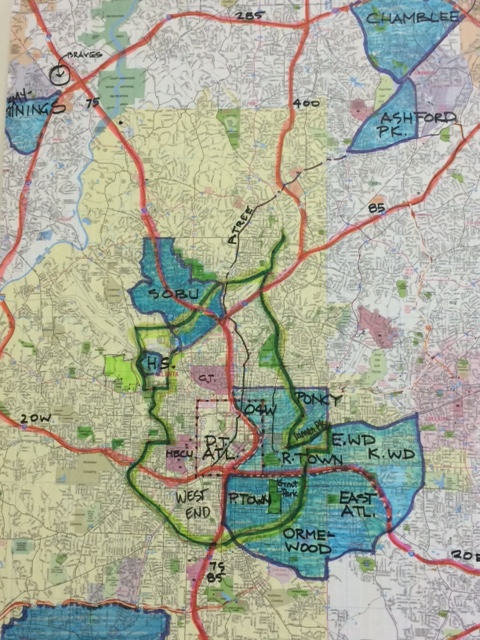
SOME RECOMMENDED NEIGHBORHOODS for price points/demographics:

I’ll start with another disclaimer: SO MUCH depends upon where the buyer and family members WORK.  Traffic in Atlanta just gets worse and worse – and commute time is precious time away from the family.  So NO neighborhood is a good neighborhood for you if your commute time is more than an hour, I’d say!  And we have good neighborhoods all around – so I usually start by asking the homebuyer, WHERE DO YOU WORK?  And then WHERE DO YOU LIKE TO PLAY/where are your friends?  And gauge the “right” neighborhood accordingly.  Another important factor is the homebuyers’ PERSONALITY.  One may HAVE to live in a walkable neighborhood while another would prefer a newer swim/tennis community. But I will do my best giving you in a general sense some of the best neighborhoods that I think exist for each price range….

Young family
1.  Under 200k: For a young family under $200,000, believe it or not there are several very good options not too far out!  I love Doraville/Chamblee.  Montgomery Elementary School is a favorite.  If they don’t mind living farther out and commute is not an issue, $200,000 will buy you a nice home in far East Cobb.  I usually recommend that the family VISIT the school personally where their child will go.  Some schools that don’t have great scores “on paper” are well loved by some of their constituents, and if there’s an IB (international baccalaureate program), a gifted child can have a great experience even at a not as great school.
2.  200-350k: Closer in East Cobb for the schools.  While the Sope Creek district is outside the range, there are a number of other great schools just a little farther out with houses in this price range.
3.  350-500k: Oakhurst, fun, diverse, walkable, family friendly.  There are also great options in Ashford Park/Drew Valley/Brookhaven Heights.   These are neighborhoods across Peachtree to the east of Historic Brookhaven.  Ashford Park Elementary is well thought of and it’s a very central location, close to I-85 and to 400.  Dunwoody is always a favorite – close in, family friendly.
4.  500k+: I can’t say enough about Decatur, as long as your work commute isn’t terrible from there.  Everyone loves City of Decatur schools, the walkability and the city services.   A lot here depends on the personality of the family!  Inman Park history might be perfect for some (with great Mary Lin Elementary), Druid Hills serenity and history (Fernbank Elementary), or for the rising corporate executive perhaps Buckhead (although homes in 30327 are generally a young family’s “second” home).

20 something
1.  Under 200k: A 20 something could go for a small condo just about anywhere they want to be.  There are even cool places in this range in the heart of Virginia Highland, in Midtown, and in Buckhead.  But if investment is also a consideration, I’d go for Doraville/Chamblee area.  With The Assembly (mixed use) development going in where the old GM Plant was, there’s a whole lot happening in this part of town.  Another great place for investment would be the historic West End – anywhere near where the Beltline WILL be going in the coming years.  There’s some awesome housing stock – great historic bungalows! And soon enough this will be the new “hip” area of town.
2.  200-350k: Ormewood Park, Reynoldstown, Kirkwood – these are the cool areas of town near the Beltline that are still affordable.  I also like SMYRNA near the Smyrna Market Village.  With the Braves Stadium moving to Cobb County, Smyrna is far enough away to avoid traffic (and you’re able to get south without getting on I-75 from there) but close enough to benefit from the development.
3.  350-500k: If they are the Buckhead type, a cool sleek condo walkable to Buckhead action!
4.  500k+: Virginia Highland, Old Fourth Ward, Inman Park, anywhere near the Beltline!

Empty nester
1.  Under 200k: On the north end of town, Kennesaw is a good option and Kennesaw Mountain is a great place to hike and to take the grandkids.  On the east side of town, Stone Mountain has some great solid one level ranch housing that might also be perfect.
2.  200-350k: In this range, a good option might be a one level ranch close to where the kids live (if the kids are in Atlanta) or close to the neighborhood they are downsizing from (to stay in touch with friends).  Lots of great neighborhoods in Tucker and nearby; Tucker has a great small town feel but is so close in, and very warm and welcoming.
3.  350-500k: I find many empty nesters in this price range love the ACTIVE ADULT communities a little farther out of town.  These generally are designed in a 4-pod pattern; basically 4 houses joined together, each all one level with a garage.  There’s a central clubhouse and pool and the exterior maintenance is generally covered by the homeowners association.  Jim Chapman is one of the prominent builders of these communities.  They are generally pretty far outside the Perimeter – there’s one near Serenbe and several which are past Alpharetta.
4.  500k+: The place historically we see empty nesters in this price category purchase is in VININGS, because taxes in Cobb County are much lower for senior citizens (the county takes off the “school” portion of the tax).  Many empty nesters end up in one of the beautiful highrises like One Vinings Mountain and The Aberdeen or buy a Weiland townhome at Paces View with an elevator.  An added bonus is that those properties are within walking distance to the Vinings Jubilee and to many awesome restaurants.

Mary Anne Walseris a licensed attorney and full-time REALTOR, serving buyers and sellers in all areas of Metro Atlanta. Her knowledge of residential real estate and her legal expertise allow her to offer great value to her clients. Mary Anne serves on the Committee that drafts and reviews the contracts utilized by all REALTORS in the State of Georgia. In addition, she is a member of the Atlanta Board of Realtors, the Georgia Association of Realtors, the State Bar of Georgia and the Georgia Association of Women Lawyers. Contact Mary Anne at 404-277-3527, or via email: maryannesellshomes@gmail.com.


Hey You, Seller! A Home Buyer’s Guide to Selling Your Home

Publication1

No, it’s not a typo – truly, this is the home BUYER’S guide to selling your home.  After all, WHO really matters when you put your home on the market?  Who do you care about?  The person who is GOING TO BUY YOUR home, right?  Well, I work with buyers each and every day and I have the inside scoop on those folks.  I’ve heard anything and everything they’ve said about homes.  Here’s what they would want you to know – let’s look at home selling from a BUYER’S perspective.

FIRST, we all know that you only have one chance to make a good first impression.  So most of the time, where is the first place our home buyer is going to see your home?  ON THE INTERNET.  And the first thing they see the first time they see your home is the first picture in your listing, so let’s start there.  First of all, professional photography with a wide angle lens is a non-negotiable.  Have professional photography.  Not having professional pictures can cost you tens of thousands of dollars.  Don’t even talk to an agent who doesn’t hire a photographer.

The first picture needs to be the front of your house.  If it isn’t, our buyer will presume something is WRONG with the front of your home.  Put your landscaper to work and make your home shine from the street.  IF that first picture isn’t great, our home buyer isn’t going to click through.  And here’s a builder’s trick – take all the screens off your front windows.  A home has a much cleaner, prettier look in pictures when there are no screens.  Put them away in case your buyer wants them – just have them off for pictures.

And let’s back up a second – how has our buyer landed on your home to even see that first picture to begin with?  They search in a given area IN THEIR PRICE RANGE.  So say our buyer can afford up to $500,000.  The homes that are going to STAND OUT are the very best homes at $500,000 and below, and those are the ones the buyer will ask their agent to show them.  If you’re the best home in the $450,000 range, you’re likely the worst home in the $500,000 price point, SO DO NOT OVERPRICE.  How are you going to know how you compare?  Hop in your agent’s car, and check out the competition.  See what homes buyers are going to see when they are out to see yours.  Make sure yours is the BEST at your price point.  If it isn’t, either make it the best or re-price so that it is.

Think you have time to wait it out and “see” if you can get a higher price?  Know it isn’t that easy.  It won’t surprise you to hear that one of the first things a buyer asks when we walk into a home is “how long has this been on the market”?  The longer on the market, the worse it is in a buyer’s mind.  If no one else wanted it, they don’t want it either.  Or if they DO want it, they presume they can get it for a bargain because it’s been on the market so long.  Buyers aren’t focused on or even aware of the fact that your home was previously overpriced and then reduced; all they know is that it’s been on the market a long time and no one else purchased it.  So overpricing and then reducing is not a good strategy either.  PRICE RIGHT FROM THE BEGINNING.  Buyers look at NEW listings, and you’ll get your most attention and activity the first few weeks on the market.

While we’re at it, let’s discuss 99 pricing strategy.  You know, where sellers price their home at $899,000 thinking that looks better than $900,000?  Well, it doesn’t.  It looks like you came from Walmart pricing school, and that’s not a good image for a $900,000 home.  You aren’t fooling anyone, and if you are fooling someone, it’s not the buyer who can afford your home.  Another reason not to 99 it = buyers search in price “bands”.  Someone who’s searching from $900,000 to $925,000 isn’t going to see your home at $899,000.  At $900,000 you’re in two searches: $875,000 to $900,000 and $900,000 to $925,000.  Round numbers land you in more searches.  More eyes on your listing means more feet in the door… and more offers on the table.

STAGING your home is a topic too involved for one article.  But from a buyer’s perspective, let me share a few secrets: first, that plastic fruit and fake plastic wine is just creepy.  Really!   It’s too desperate and makes it look like you’re trying too hard, and buyers talk about the “fake” stuff and not the real house.  That and the fake television sets!  Stage with real things.  Minimize clutter and personal items, especially things that might draw attention away from your home.  And think about your target buyer – if your target buyer is a first time home buying millennial, by all means get a millennial into your home (a truthful and candid one, preferably) and walk around with them.  My guess is they’ll tell you to get rid of the doilies AND that fake plastic fruit.  Also ask if there’s any discernible smell.  You, seller, have gotten used to the smells in your home and there’s no way you can be objective about that either.  Keep in mind that CLEANING PRODUCT, particularly anything lemon scented, is usually a great smell.  You don’t want to mask your smells, you want to eliminate the bad and bring in the good.  Be open minded, have a tough skin, and ask for frank feedback.

FINALLY, your buyer wants you to know to LEAVE THE BUYER CHOCOLATE CHIP COOKIES.  Bake chocolate chip cookies and leave a note so the buyer will know they can eat one.  Everything looks better on chocolate!  Leave another note detailing what you love about the home and the neighborhood.  Buyers buy emotionally – they may justify logically, but they buy emotionally.  Chocolate chip cookies and a handwritten note ARE appreciated.   It is usually just one out of twenty homes that will leave cookies and a note, and it always makes an impression.

SO, there you have it – your home buyer’s guide to selling your home.  Always try to look at your home and the process from the perspective of the buyer you seek!

Mary Anne Walser is a licensed attorney and full-time REALTOR, serving buyers and sellers in all areas of Metro Atlanta. Her knowledge of residential real estate and her legal expertise allow her to offer great value to her clients. Mary Anne serves on the Committee that drafts and reviews the contracts utilized by all REALTORS in the State of Georgia. In addition, she is a member of the Atlanta Board of Realtors, the Georgia Association of Realtors, the State Bar of Georgia and the Georgia Association of Women Lawyers. Contact Mary Anne at 404-277-3527, or via email: maryannesellshomes@gmail.com.

THE WEATHER TURNS COOL, BUT THESE ATLANTA NEIGHBORHOODS ARE HOT!

Tags

, , , , , , , , , ,

Hot NeighborhoodsAtlanta has SO many great neighborhoods!  But here’s a quick take on what are some of our hottest (of the moment) neighborhoods and those that are HOT VALUE neighborhoods NOW, this Fall, 2015, in Atlanta.  Note the distinction.  When a neighborhood is “HOT” – i.e., very popular at the moment, oftentimes prices will rise rapidly as buyers bid against each other in their rush to move in.  A HOT VALUE neighborhood is one that is not yet “RED HOT” but which WILL be hot in the coming years, and so there are still bargains to be had.  Now, if you’re bidding in a HOT neighborhood and prices are rising, there is no need to fear overpaying as long as it’s a neighborhood that is likely to hold or increase in value in the coming years.  Usually a neighborhood is HOT either because of location, schools, or both; the location isn’t going to change and if the schools are good, residents always fight to KEEP them that way.

Don’t be concerned that I am leaving out your favorite HOT neighborhood – know that I’m not addressing CLASSICALLY HOT neighborhoods… I’m not addressing them in this particular blog post because they are always hot.  This would include Decatur zip 30030, Midtown, Va/Hi, Morningside, and many northern suburbs such as Alpharetta, Roswell, Johns Creek, and East Cobb in its great school districts.

And also know that there’s no way to address all the “hot” areas in one blog post – I’ll just touch on a few to whet your appetite, and I’ll cover different areas of town.

Let’s start in Ashford Park, just east of Peachtree Road – Ashford Park is HOT.  The elementary school is awesome and there’s lots of new construction.  While several years ago one could get a pretty decent home for $300,000 here, I just sold a teardown LOT for $500,000 with multiple offers in one day.

HOT VALUE near there is CHAMBLEE.  While Montgomery Elementary is not yet par with Ashford Park, it’s getting there, and the City of Chamblee is making great strides in developing retail areas.  THE ASSEMBLY huge mixed use development is going in where the old GM Plant used to be and that’s exciting.  Because it’s up and coming, there are still values to be had.

NOW, let’s go to the Beltline, which is of course driving values everywhere it touches.  We’ll start with Old Fourth Ward, O4W in local parlance, and its neighbors, Inman Park and Poncey Highland.  HOT because of the Beltline (and that’s a continuing theme – the Beltline has made many Atlanta neighborhoods “HOT” so it is important to know where the Beltline IS, where it will be, and where it’s going…. ).  Quick aside = the Beltline is a 22 mile bike/walk/run path being built in a huge Atlanta circle.  Only parts of it are complete, other parts are underway, and some sections may be years in the making. But the O4W portion is complete and with it O4W Park, Ponce City Market, Krog Street Market – the list of “cool” things that have come with it are legion.

HOT VALUE is south of there, in Reynoldstown, Edgewood, and East Atlanta.  There’s also Ormewood Park, nestled between Grant Park and E Atlanta on the Southside (Grant Park has been and continues to be a “hot” area).  The beltline goes right through this great neighborhood of old bungalows and great diversity.  There is section 8 housing a block from $700,000 homes.  There are still a lot of values to be had – I just sold a $250,000 adorable house one block from the Beltline.  The Beltline here is not yet finished, so prices haven’t risen SO high SO fast.

For more hot values, seek out Capitol View Manor, Mechanicsville, and Adair Park – neighborhoods to the west of the afore-mentioned neighborhoods.  These are nestled in west of I-75/85 and south of I-20, and the Beltline goes right beside and through them.

Let’s leave the Beltline for a minute and head down towards to the Airport to stop at The Manchester Arms in College Park for a meal.  Marvel at what College Park is becoming.  Because Woodward Academy is down there, some northern suburb dwellers have built weekday homes for one spouse and the kids to live in before they go back to the northern burbs for the weekend.  PORSCHE moving into the airport has meant even more wealth moving into the area.  College Park is hot; East Point just to the north of it is still a hot value neighborhood.

Back on the Beltline and moving North; HOT is BRANDON SCHOOL DISTRICT = you’ll pay a premium for great public schools in Atlanta, and Brandon is a good indicator of that.  One of my favorite neighborhoods is CHANNING VALLEY, where prices have risen 22% over PRE recession prices; it’s a small friendly diverse neighborhood in a great convenient spot.

HOT VALUE is West Midtown = Howell Station is an example.  It’s near BELLWOOD QUARRY, which saw thousands of zombies in the season premiere of Walking Dead.  Now that the zombies are gone, that park will be the crown jewel of the Beltline.  Because that area is still very industrial and the Atlanta Jail is nearby, prices are still low, but demand is rising.

And finally, up North to just outside the Perimeter.  Smyrna west of 285, just outside Vinings, the area nicknamed “Smynings” is hot but there are also still a lot of value priced properties.  With the new Braves Stadium going in, it’s becoming even more desirable as a place that will be close to the action and the new development; and yet far enough west that residents can still get places without running too much into Braves traffic.

Again, these are just a FEW of the “hot” areas that I am seeing.  Please email me YOUR favorites so that I can feature them in a future blogpost!

 Mary Anne Walser is a licensed attorney and full-time REALTOR, serving buyers and sellers in all areas of Metro Atlanta. Her knowledge of residential real estate and her legal expertise allow her to offer great value to her clients. Mary Anne serves on the Committee that drafts and reviews the contracts utilized by all REALTORS in the State of Georgia. In addition, she is a member of the Atlanta Board of Realtors, the Georgia Association of Realtors, the State Bar of Georgia and the Georgia Association of Women Lawyers. Contact Mary Anne at 404-277-3527, or via email: maryannesellshomes@gmail.com.

No Need to Cork the Bubbly – Let’s Celebrate the Recovery

Tags

, , , , , , , ,

champagne-300x300

After the dismal housing recession in Atlanta (and everywhere) that hit in 2008 and sent housing prices on a sharp decline,  prices finally started to stabilize in late 2014 and have risen ever since.  Having just emerged from the doldrums to a rapid rise in pricing, some experts are declaring a new “housing bubble”; but reports of the imminent death of the rising residential market are greatly exaggerated.

In Atlanta, we took longer to sink during the recession and have been slower to rise in the recovery.  Right now we have a shortage of inventory but our prices still are not rising as quickly as they are in many cities.  This measured response to the national trends bodes well for us; as does the fact that so many companies are bringing headquarters and employees to Atlanta.  We have more buyers moving here, which will naturally put upward pressure on pricing, but which will serve to continue to support that pricing in the coming years as they continue to live and work in Atlanta.

In addition, as more sellers receive the news that housing prices are rising and that they ARE able to sell and make a profit, more are putting their homes on the market.  This additional inventory is helping to reduce the number of competitive bid situations and to stabilize the rapid rise in pricing.

Further, it was a very loose mortgage lending environment that contributed to the original housing bubble.  It was far too easy to get a mortgage at that time.   That loose mortgage environment ground to a screeching halt in 2009 and it is still difficult today to secure a mortgage.  The strict underwriting guidelines that were implemented following the “mortgage meltdown” are still in place, meaning that the torrent of unqualified buyers that precipitated the initial crisis are nowhere to be found and are, hopefully, never to return.  Banks are lending only to qualified buyers with good credit scores who are less likely to default on their mortgage loans.  Interest rates are still low right now, but are likely to rise, which will create yet another governor on the ability of buyers to purchase and the ability of sellers to ask ever increasing prices.

After fifteen years in the business, I have seen a lot of ups and downs in the housing market.  This particular recovery, while fast, has not spun out of control and is unlikely to do so.   While it’s always prudent for a buyer to carefully review the sales of comparable properties and to research the  neighborhood and factors contributing to that neighborhood’s potential before agreeing on price, and although that price is going to be higher than it was three to five years ago, there’s no need to panic or to cork the bubbly over a housing “bubble”.  Rather, we should continue to celebrate the housing recovery.

Mary Anne Walser is a licensed attorney and full-time REALTOR, serving buyers and sellers in all areas of Metro Atlanta. Her knowledge of residential real estate and her legal expertise allow her to offer great value to her clients. Mary Anne serves on the Committee that drafts and reviews the contracts utilized by all REALTORS in the State of Georgia. In addition, she is a member of the Atlanta Board of Realtors, the Georgia Association of Realtors, the State Bar of Georgia and the Georgia Association of Women Lawyers. Contact Mary Anne at 404-277-3527, or via email: maryannesellshomes@gmail.com.