What’s Up with the Down Stock Market and the US Credit Rating?

Last week, the Dow Jones industrial average plunged to its lowest level since the low in 2008… S&P lowered its credit rating of theUS…. what does this mean for real estate (since, of course, it’s all about real estate for a Realtor)?  While I’m not an economist, I thought I would share my perspective and the latest home sales statistics for theAtlanta,Georgiamarket (my home).

When the stock market goes down precipitously, many homebuyers panic and think it’s a bad time to BUY a home – of course, it’s the exact opposite.  When the economy is down, THAT is the time to purchase.  We’ve seen opportunities never seen before in the real estate market in current years.  These are the times when fortunes are made in real estate – buy LOW (that’s now) and sell HIGH (and “high” times WILL come again – they always do!)

I’m not sure what, if any effect, the events will have on mortgage interest rates.  In addition to lowering the US Debt Credit rating, S&P also lowered the rating of Freddie Mac and Fannie Mae.  These two entities buy most of the mortgages issued in this country, allowing banks to finance more home sales.  But what I understand is that since mortgage rates are tied to long-term Treasury yields, and Treasuries are considered a safe investment in uncertain times, mortgage rates are unlikely to rise because Treasuries will continue to do well.

 I work in the Buckhead Market Center of Keller Williams Realty – part of the Rawls Group.  Each quarter the Rawls group commissions an in-depth survey of the home buying/selling activity in Metro Atlanta for the preceding quarter.  The findings for the 2nd quarter of 2011 show some interesting trends.  Sales were actually HIGHER – up 3 percent as compared to the 2nd quarter of 2010, but distressed properties still represent a large percentage of total sales – 40.9%, which is providing a downward pressure on pricing.

Here’s chart showing the home sales trends for the past three years in Metro Atlanta: 
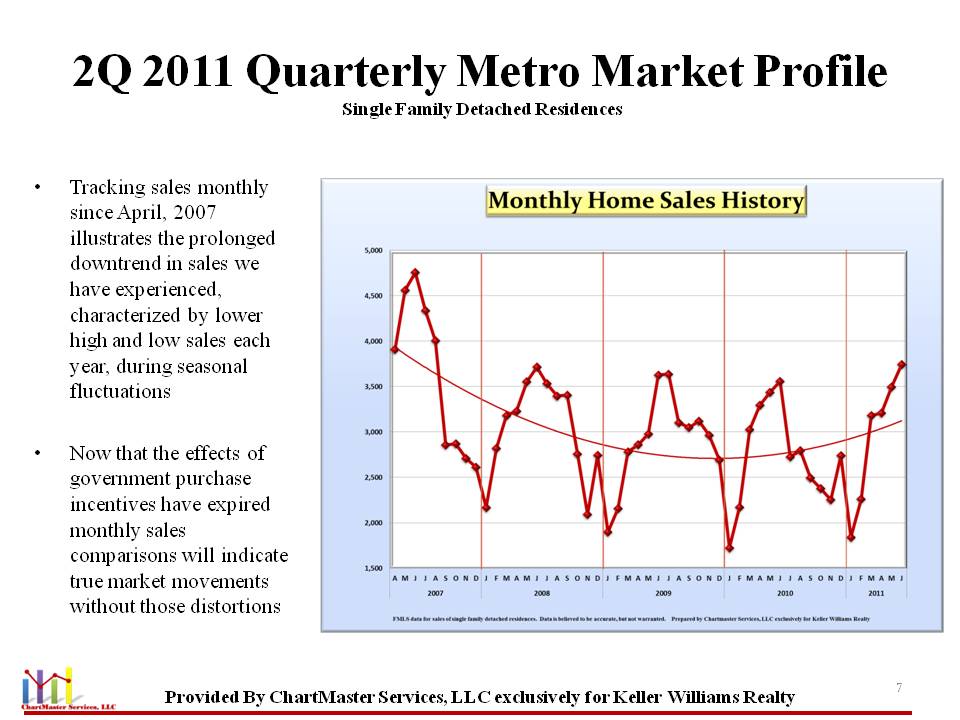
RELEVANCE FOR SELLERS: Current buyer price resistance is still very high due to the availability of low priced distressed properties.  Among all levels of listings, most (more than eighty percent) required a price reduction prior to sale, meaning that sellers are overpricing their homes intially.  Overall the LISTING INVENTORY is lower, but we still have 7 months of listing inventory, indicating that we are still in a strong buyer’s market.  (7 months of listing inventory means that if NO OTHER properties came on the market, it would take 7 months to sell the inventory currently in play).

RELEVANCE FOR BUYERS: there is an unusual opportunity, as noted above, for GREAT VALUE in purchasing a home.  Prices are still declining, there are many listings available, and a great number of anxious sellers.

Here’s a chart showing the percentage of sales that are DISTRESSED property sales:

With the fall in the stock market, even more opportunity is open to buyers savvy enough to know that NOW is the time to buy.  For sellers, there will be continued downward pressure on pricing until the market stabilizes.   We will be VERY interested to see what effect recent events have on our stats NEXT quarter!

Aside

What is “Midcentury Modern”?

Tags

, , , , ,

A popular housing description these days is the term “midcentury modern” – but what does that mean?  Basically, a midcentury modern home is a 1950s or 60s ranch that has been “modernized” into a more contemporary home in some way.  Usually at a minimum the term implies that the home has been opened up-that walls have removed so that the floor plan is more “open”. 

On the exterior, the sleek horizontal lines of these homes are reminiscent of the work of Frank Lloyd Wright. Think of his masterpiece Fallingwater-the eye is drawn side to side rather than up.  It is a style more of the earth than of the sky.  Specific external elements can emphasize this.  In this Atlanta midcentury modern at 1931 Dellwood Drive in Collier Hills, slender horizontal wood slats offer privacy for the patio they hide but also serve as a design element.

During the time period when ranches were built, gravel beds were also popular.  At Dellwood, the owner added this easy maintenance landscaping bed at the home’s entrance to add to the vintage feel. One distinguishing feature found in some, not all, midcentury modern homes is the carport attached to the front of the home-side entry, for a more uniform “face” towards the street.

Midcentury moderns are almost always brick-the predominant building material for ranch houses in the South at that time.  Painting the brick can further the modern feel-or, if combined with other classic elements such as columns, result in a mid century classic home.

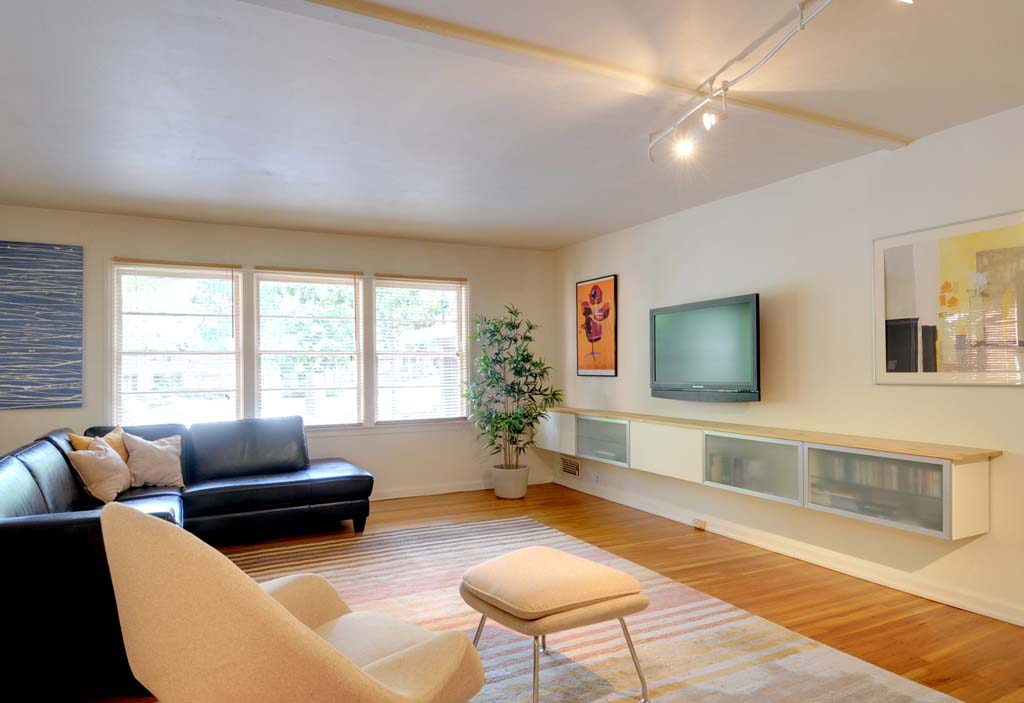
On the interior, typically ceilings are low, typical of the period, but any popcorn texturing is removed to further advance the “sleek” and modern feel.  Here at the Dellwood property the homeowner chooses a monochromatic color scheme with “pops” of color.  Modern implies minimalistic, so the basic colors are neutral, but modern style is also “fun” – popular color accents are orange-red, green, and bright blue.

The kitchen is often modernized also- for a low budget redo, painting the cabinets a glossy white and replacing the hardware with more modern pulls and replacing linoleum with silestone, granite or corian will do.  While when built, these kitchens were typically contained, in the midcentury modern style at least one wall is opened up to the living area.

Midcentury moderns are one story dwellings.  The ranch style was designed to be the perfect melding of easy living with inexpensive construction in an era when land was cheaper than it is today.  Today, a large part of the cost of a home is the land on which it sits.  (The simplified builder’s equation is that the lot should be one third of the final selling price for the home-such that a builder might expect to pay $500,000 for the lot on which she builds a $1.5 million dollar home).  So most new homes today are at least two stories, taking full advantage of the size of the lot. 

Ranch homes were built for the post-war homebuyers eager to nest.  In 1945 millions of American soldiers returned from the war to find the biggest housing shortage theUShas known.  Ranch homes were inexpensive to build and served the needs of these new homebuyers well.

Tastes then were undoubtedly different than they are for us today-beautiful hardwood floors were covered with carpet.  It’s not unusual to find ranch homes where that is still the case, but as ranches are virtually all now in the hands of a new generation of buyers, carpet covering hardwoods is the exception rather than the rule, and these younger buyers have adapted the style to fit their tastes.

Midcentury homes-some modern, some classic, some retro- are ubiquitous in many parts ofAtlanta.  In some neighborhoods, likeAshfordPark, many of them have been torn down to make way for newer, larger homes.  In Buckhead, a fully renovated midcentury modern can go for more than $500,000. 

This one is onDellwood Drivein Collier Hills.  The street is somewhat of an anamoly-most of Collier Hills consists of older 1920-1930s cottages, but this street was built in the 1950s.  This home was originally built as a triplex-the upstairs was two units that have now been opened up into one large space.  There’s still a separate rentable apartment downstairs.

As with any housing descriptive term, there’s no way to define definitively what “midcentury modern” means, as it means different things to different people.  But the homes that have become midcentury modern show that a classic style such as the ranch, with a few adaptations, can still meet the needs of a new generation of homebuyers.